The 5Cs Model

An evidence-based framework for understanding and improving team cohesion and organizational culture. It identifies five core drivers that shape how people feel and perform at work.

Meet the 5Cs

THE DRIVERS OF CULTURE

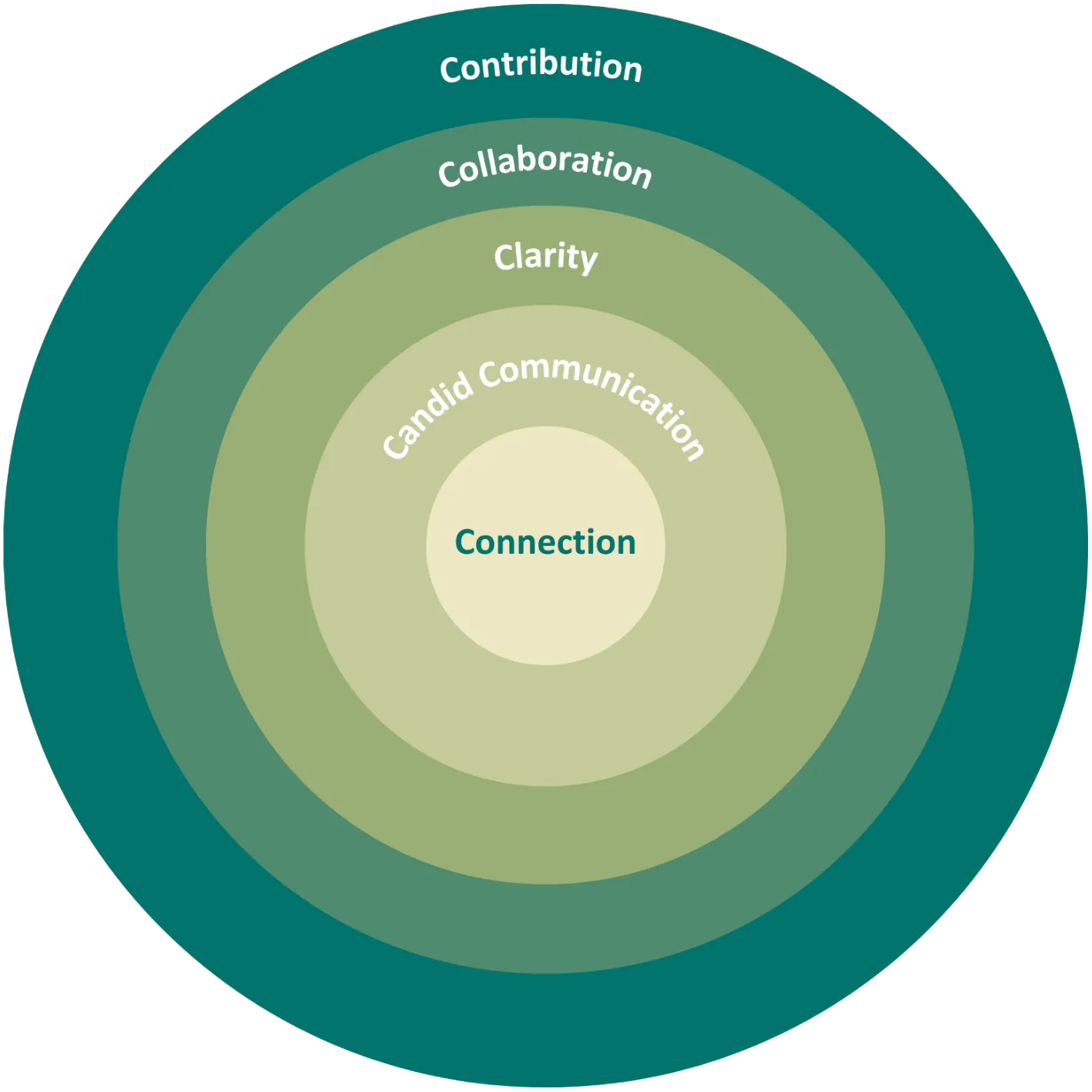
Traditional engagement tools often describe how people feel, but not why. The 5Cs isolate underlying drivers—how people connect, communicate candidly, understand priorities, collaborate, and see their contribution—so leaders can address root causes instead of chasing short-term bumps.

Contribution

Contribution reflects how team actions align with the organization's core values and goals. It incorporates the impact that the team and organization has on the broader community, the existence and acceptance of key core values that drive actions and discussions, the recognition of meaning and mattering and their importance to people thriving, and creating company-wide alignment on a shared vision that provides direction and purpose.

Collaboration

Collaboration measures how well people support each other and hold each other accountable for their performance. It is reflected through the existence of strong team support, commitment to accountability in a fair and consistent way, and a drive toward excellence in team and individual performance.

Clarity

Clarity in a team and organization refers to how clear people are in terms of their responsibilities, the processes they follow, and the overarching goals. Clarity can be achieved through delineating roles and responsibilities and their associated expectations, clearly defining workflows and processes, and creating and constantly striving toward shared goals.

Candid Communication

Candid Communication is about straightforward, unambiguous discourse among all members of the team and organization. It can be fostered through psychological safety, which is seen through people's willingness to take interpersonal risk, the important two-way processes of healthy conflict and feedback, transparency and openness of information sharing, and ideas meritocracy, which reflects the willingness of leaders and managers to listen to ideas.

Connection

Connection within a team and organization reflects the ties that members feel with the entity's ethos and with their colleagues. Connection encapsulates a deep sense of mutual trust that goes beyond mere association or involvement, and well-being that includes the physical, mental, and emotional health of members of the team and organization.

Contribution

Collaboration

Clarity

Candid Communication

Connection

The 5Cs Outcomes

Explain about 50% of the variance in overall employee job satisfaction.

Show that Candid Communication is the best predictor of performance.

Explain nearly 80% of the variance in satisfaction with organizational culture.

Show that Connection is the most predictive of job satisfaction.

The Principles 5Cs Assessment

Organizations put the 5Cs Model into a repeatable, data-driven process through the Principles 5Cs Assessment, a validated diagnostic that measures each of the five drivers and pinpoints where to focus. The assessment helps leaders:

1

Assess

Teams, functions, or the full organization against the 5Cs.

2

Prioritize

Strengths, gaps, and misalignments using clear data.

3

Act

With targeted plays, leader guides, and practical rituals linked to each C.

4

Re-Assess

To track trends and demonstrate progress over time.

Use Cases

For Executives & People Leaders

Org-Wide Culture

Use the Principles 5Cs Assessment to get an
enterprise-level view of culture:

Organization-wide read on Connection, Candid Communication, Clarity, Collaboration, and Contribution.

Dashboards that pinpoint where culture is helping or hindering performance across teams, divisions, and functions.

Shared language and metrics that align executives, HR, and leaders on what "good" looks like.

Guided leader playbooks and resources that translate insights into measurable next steps.

Ideal for: Boards, ELTs, Chief People Officers, and People leaders who need a quantitative roadmap for culture and clear reporting over time.

For People Managers

Team-Level Culture

Deploy the 5Cs at the team level to give managers fast, practical insight:

Actionable diagnosis of team health across the 5Cs.

Ready-to-use playbooks and resources (i.e. prompts, meeting rituals, behavior checklists).

Shared language and metrics for expectations and accountability.

Under 10-minute participation and simple readouts managers can use immediately.

Best for: Functional leaders and frontline managers who want a clear roadmap for improving team communication, clarity, and collaboration.

Pilot Programs, Targeted Interventions & Scaling

Organizations can:

Start with selected groups (for example, a division, region, or critical function).

Expand using the same 5Cs framework and metrics once the model is proven internally.

Run pulses over time to track trends and demonstrate progress for leaders and boards.

Keeps the focus consistent-Assess → Prioritize → Act → Re-assess-whether you're improving one team or the entire organization.

Best for: Functional leaders and frontline managers who want a clear roadmap for improving team communication, clarity, and collaboration.

Go Deeper:
The 5Cs Framework

Understand the research behind the drivers of team performance and culture.

Our white paper explains how Connection, Candid Communication, Clarity, Collaboration, and Contribution work together to strengthen teams and organizations.

Ready to Talk?

If you’re a CEO or senior leader who wants measurable progress—without added noise—let’s connect.

ConnectedCulture-3d

Get the first chapter FREE

#1 New Release — Workplace Behavior & Business Teams