When communication breaks down, trust erodes, and performance stalls, most teams try to fix symptoms instead of root causes. The 5Cs model provides a structured way to diagnose and strengthen the conditions that drive sustainable team performance.
Table of Contents
After 15 years of research, McKinsey found a successful culture transformation is the exception, at 30%, not the norm.
Sadly, high performing teams are also the minority in organizations, with 18% of senior leadership teams and 30% of all teams operating as such.
What makes transforming culture and improving team cohesion so challenging?
Culture transformation feels elusive. It is big and takes a long time. People can give up because they don’t have a roadmap, understand how the pieces are interconnected, or see change fast enough.
Improving teams and culture feels intangible until it can be measured. Yet, there is a lack of evidence-based measurements on the elements that create thriving culture and teams. Instead, employee engagement is one of the most used organizational metrics, which is the outcome companies want to achieve. However, simply measuring and getting the engagement score does not provide insight to the levers that actually impact engagement. This leaves organizations to essentially guess whether the efforts they take truly make a difference.
Transforming culture doesn’t happen instantaneously. Research shows it takes an average of three years to successfully transform culture when approached effectively; so, it’s easy to get lost along the way. Without the ability to look at true evidence-based measurements, leaders in organizations are not able to see the full effect of all the different components coming together as a roadmap or journey.
While teams are often aware of foundational elements they can focus on, including trust and psychological safety, they don’t know all the elements that create thriving teams. Additionally, at times, teams see problems surface but don’t have solutions to fix the issues.
These challenges highlight the need to create real solutions to improve teams and culture.
Why Teams Struggle to Perform
Many leadership teams experience the same patterns:
- Miscommunication slows decision-making
- Accountability becomes inconsistent
- Trust begins to erode
- Performance plateaus despite effort
These issues are rarely caused by individual capability. They are usually the result of unclear expectations, weak alignment, or missing feedback systems.
The 5Cs model helps teams identify these breakdowns and create the conditions for sustained performance.
The Story Behind the 5Cs Model
Before developing the 5Cs model, I saw two issues that inhibited meaningful team and culture transformations:
- It’s challenging for organizations to create a comprehensive approach to culture change.
- There isn’t a simple model that encapsulates all of the latest research on what we know about high performing teams and cultures.
After identifying these two huge gaps in the marketplace, our organization’s research center, the LOV Center, in partnership with the Principles team, conducted extensive research to address them. The goals were to understand the known elements that improve team cohesion and culture and how to start measuring these elements in organizations.
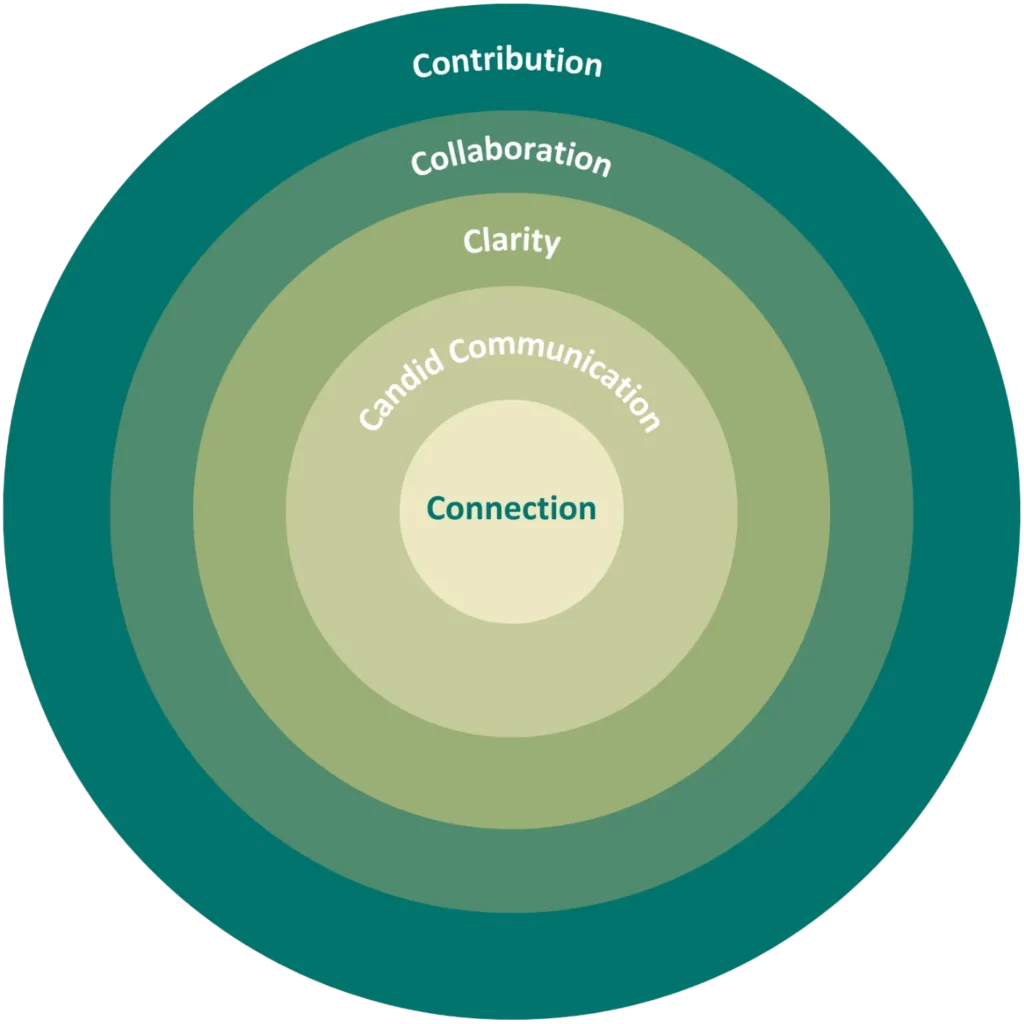
We discovered and developed the 5Cs. The 5Cs tool is an evidence-based model that captures the five critical elements to create high performing teams and thriving cultures. The tool addresses the challenges organizations face to improve teams and culture by:
- Providing a roadmap to improve culture and teams so everyone understands how the pieces are interconnected, what to focus on first and where they are in the journey
- Giving teams, leaders, executives and boards the insight into what the organization is focused on and why
- Measuring and tracking progress to know if the team and organization are successful in their efforts for improvement
- Offering details subfactors for each element so leaders can focus on targeted solutions
The 5 Key Elements to Improve Team Cohesion and Culture
The 5Cs represent the conditions that shape how teams function together. When these conditions are strong, teams communicate more effectively, move faster, and perform with greater consistency. When they weaken, friction increases and performance suffers.
Connection
What it means
Connection reflects the level of trust, care, and shared understanding within a team. It shapes whether people feel supported, respected, and genuinely connected to the people and purpose around them.
Why it matters
Teams do not perform at a high level without trust. Strong connection creates the foundation for honest conversations, healthy conflict, collaboration, and long-term resilience.
What happens when it is missing
- Trust erodes
- Conversations stay surface-level
- People disengage from the team and its goals
Candid Communication
What it means
Candid communication measures how openly and directly people share information, perspectives, concerns, and feedback.
Why it matters
Teams make better decisions when people are willing to speak honestly and address difficult issues early. Without candid communication, important problems remain hidden until they become larger and more disruptive.
What happens when it is missing
- Feedback is avoided or softened
- Concerns surface too late
- Decisions are made without full visibility
Clarity
What it means
Clarity reflects how well people understand priorities, expectations, responsibilities, and shared goals.
Why it matters
Teams cannot perform consistently when direction is unclear. Shared understanding creates alignment, reduces friction, and helps teams execute with confidence.
What happens when it is missing
- Work slows down
- Priorities compete with one another
- Accountability becomes inconsistent
Collaboration
What it means
Collaboration reflects how effectively people support one another, work through challenges together, and hold each other accountable for performance.
Why it matters
Strong collaboration allows teams to combine perspectives, solve problems more effectively, and execute with greater consistency across functions and roles.
What happens when it is missing
- Silos form
- Work becomes fragmented
- Teams struggle to maintain momentum
Contribution
What it means
Contribution reflects how individual actions connect to the broader goals, values, and impact of the organization.
Why it matters
People perform at a higher level when they understand how their work matters. Strong contribution creates alignment between individual effort and organizational purpose.
What happens when it is missing
- Engagement drops
- Work feels disconnected from the bigger picture
- Motivation and performance become inconsistent
The 5Cs model provides a practical way to understand and strengthen team culture. Together, these five conditions help organizations build stronger communication, clearer alignment, healthier collaboration, and more consistent performance.
Why the 5Cs Matters Now
- Leadership teams are expected to move faster than ever
- Decisions are more complex and more visible
- Misalignment is now a business risk, not a culture issue
Why the 5Cs vs. other models
- Focuses on how teams function together, not personality types
- Diagnoses the conditions that drive performance
- Connects culture directly to decision quality and execution speed
How the 5Cs Model Is Used in Practice
Organizations use the 5Cs model to:
- Diagnose team performance challenges
- Improve leadership communication
- Strengthen accountability
- Align priorities across departments
- Build sustainable culture
The model is not a personality assessment or engagement survey. It is a practical diagnostic tool that helps teams understand how they function together.
What Leaders See Before and After Using the 5Cs
Before the 5Cs
Symptoms
Misalignment
Slow decisions
Low trust
Confusion
After the 5Cs
Outcomes
Clear priorities
Faster decisions
Stronger trust
Consistent performance
Assess Your Team Using the 5Cs Framework
If your team is experiencing recurring communication challenges, slow decision-making, or inconsistent performance, the next step is to measure the conditions driving those outcomes.
The 5Cs assessment provides a structured way to identify strengths, gaps, and opportunities for improvement.