I’ll admit something that surprises people, given what I do for a living. I believe deeply in manifestation. I believe in getting vividly clear about what you want, seeing it before it exists, and building your life toward it on purpose.
I just don’t believe in the version most people practice, and neither does the research.
The popular version goes like this: picture the outcome in detail, feel how good it will be, and trust that clarity and energy will pull it toward you. If you’ve tried it, you may have noticed what I have. You imagine the win, you feel great for an afternoon, and then remarkably little moves. That isn’t a willpower failure. It turns out pure positive fantasy can quietly work against you.
The psychologist Gabriele Oettingen has spent decades on this. Her research found that vividly fantasizing about a desired outcome can actually lower your energy and effort toward reaching it, and across several studies it was tied to worse real-world results, from less weight lost to fewer job offers. Imagining you’ve already arrived hands you a taste of the reward before you’ve done anything, which drains the drive to go get it. “Just visualize it” isn’t neutral. It can be the thing holding you back.

What actually works
The version that holds up is something Oettingen calls mental contrasting. You picture what you want, then you look honestly at the real obstacle standing between you and it, then you make a plan for that obstacle. Vision paired with reality, not vision alone. Get clear about the future you want, look squarely at where you actually are, and act to close the gap.
That already describes a lot of high performers. You set a vision and you drive at it relentlessly. Which is why the place manifestation tends to break for people like us isn’t the vision or the effort. It’s the grip.

The part high performers get wrong
When something I care about isn’t moving, my instinct is to push harder. More work, more thinking, more control. If you’ve built a career on making things happen, you know the feeling. The project stalls, so you rewrite your team’s work yourself. You check for an update you already asked for. You add a status meeting because the quiet feels like drift. You reopen a decision you already made, though nothing new has come in.
Past a certain point, none of it works. And there’s a specific line most of us cross without noticing: the point where we’re no longer pursuing the outcome. We’re just trying to escape the discomfort of not being able to control it. Those are two very different things. The opposite of control isn’t passivity. It’s intention without attachment.
The research on choking under pressure shows why the extra control backfires. When skilled people start consciously monitoring and controlling something they’d normally do fluidly, their performance drops. The step-by-step attention meant to help is the thing that interrupts them. Leaders do a version of this constantly. You take over the work your team should own, and you weaken their judgment and their ownership. You keep reworking a decision, and you talk yourself out of a good one. You pile on oversight to move faster, and you get more caution and less creativity. The control feels responsible. Often it’s just interference.
There’s also a reason the answer so often arrives on a walk, in the shower, or the next morning, right after you stop forcing it. Stepping back from a stuck problem isn’t the same as giving up on it. Your mind keeps working while you loosen your grip, free to drop the approach that wasn’t landing and reach associations it couldn’t find while you were staring straight at it.

Manifestation and surrender aren’t opposites
I used to think they were. Now I think they need each other. Manifestation without action is fantasy. Action without intention is motion. And intention without surrender can become control.
Almost nothing I’ve built arrived the way I would have designed it. The people, the openings, the detours that only made sense in hindsight, I couldn’t have scripted any of them. Had I stayed attached to the exact route I first imagined, I would have missed most of them. The vision was right. The script I wrote for how it had to happen was not.
Here I’ll separate what I believe from what I can prove. I can’t prove anything shifts energetically when we let go, and I’m comfortable leaving that question open. But the rest is well supported: clarity about the future helps only when it’s joined to an honest look at the present, real action, and enough looseness to recognize a better path when it appears.
The highest-agency move
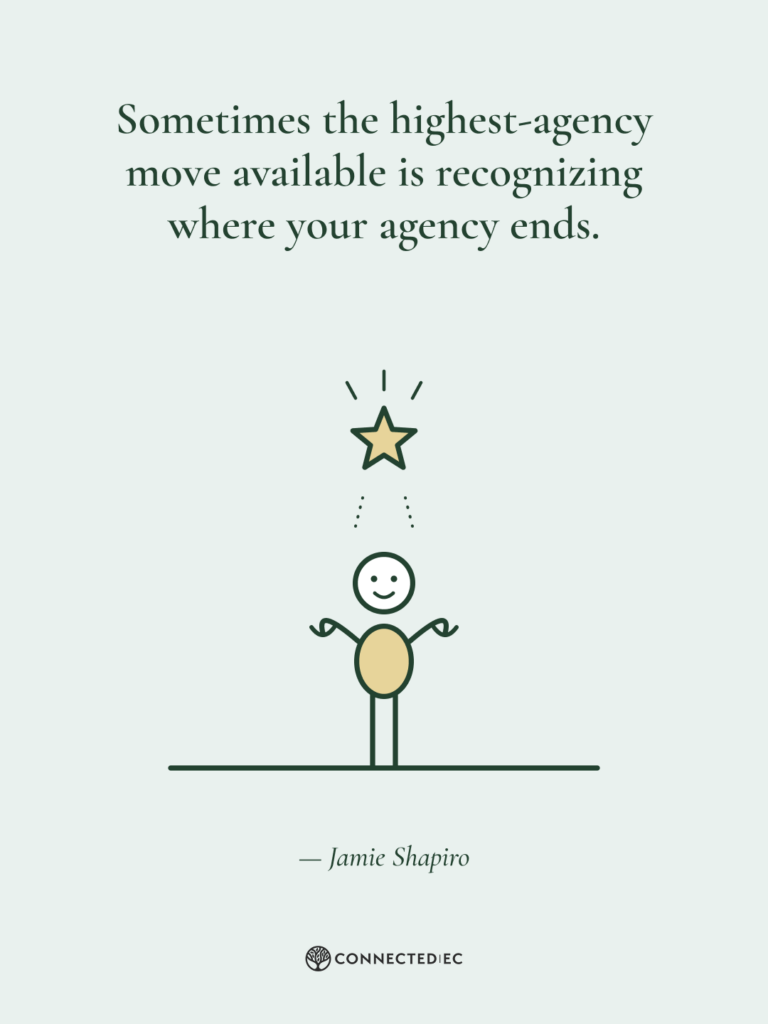
One idea I return to constantly is to control the controllables. The trouble is that when we care deeply, we start mistaking caring more for controlling more. Another hour must beat stopping. Another push must beat waiting. But sometimes the highest-agency move available is recognizing where your agency ends. Letting go doesn’t mean lowering the goal or going passive. It means doing everything that’s genuinely yours to do without assuming everything is yours to control.
So real manifestation, the kind that works, isn’t wishing and waiting. It’s holding the vision clearly, working toward it honestly, and loosening your grip enough to let the path surprise you. Catch the moment when agency becomes force, when the next action isn’t moving anything and the next attempt at control is just your grip tightening. That is the moment to let go. Not of the vision or the work, just of your insistence that you know exactly how it has to unfold.
Hold the vision. Loosen your grip.
— Jamie