Every C-suite deals with challenges in strategy, talent, and execution. But those are just a few of the issues leadership teams navigate every day.
Across the teams I have worked with, a consistent set of patterns shows up beneath these challenges.
Leaders face questions around visibility, alignment, trust, decision-making, and how they operate together as a team.
These issues don’t appear in isolation. They’re interconnected, and they shape far more than individual outcomes.
After two decades of coaching CEOs and their executive teams, one thing is clear: how the C-suite functions together ultimately determines how the organization performs.
What Sits Beneath These Challenges
Across hundreds of executive teams I’ve worked with, these issues show up consistently, regardless of industry, geography, or stage of growth.
Strategy, talent, and execution challenges are real. But they don’t exist in isolation.
They’re shaped by how the C-suite operates together.
Leaders underestimate how visible they are. They become increasingly disconnected from what’s actually happening on the ground.
They default to functional thinking instead of operating as an enterprise team. And over time, misalignment creeps into how decisions get made and how priorities are set.
This is what makes these issues so consequential.
The C-suite is the most influential team in the organization. How it functions, individually and collectively, shapes trust, clarity, and execution across every level.
When the team is aligned, the organization moves with focus. When it’s not, the friction is felt everywhere.
Where Leaders Misdiagnose the Problem
What I’ve learned, and what still surprises leaders when I name it, is that C-suite underperformance is almost never a capability problem. The people in the room are extraordinary. The breakdown is relational and systemic. It lives in the space between people, not inside any one of them.
When leaders haven’t built shared norms, when trust is thin, when each person is optimizing for their own domain the whole suffers, even if every individual is exceptional.
The Signal the Organization Follows
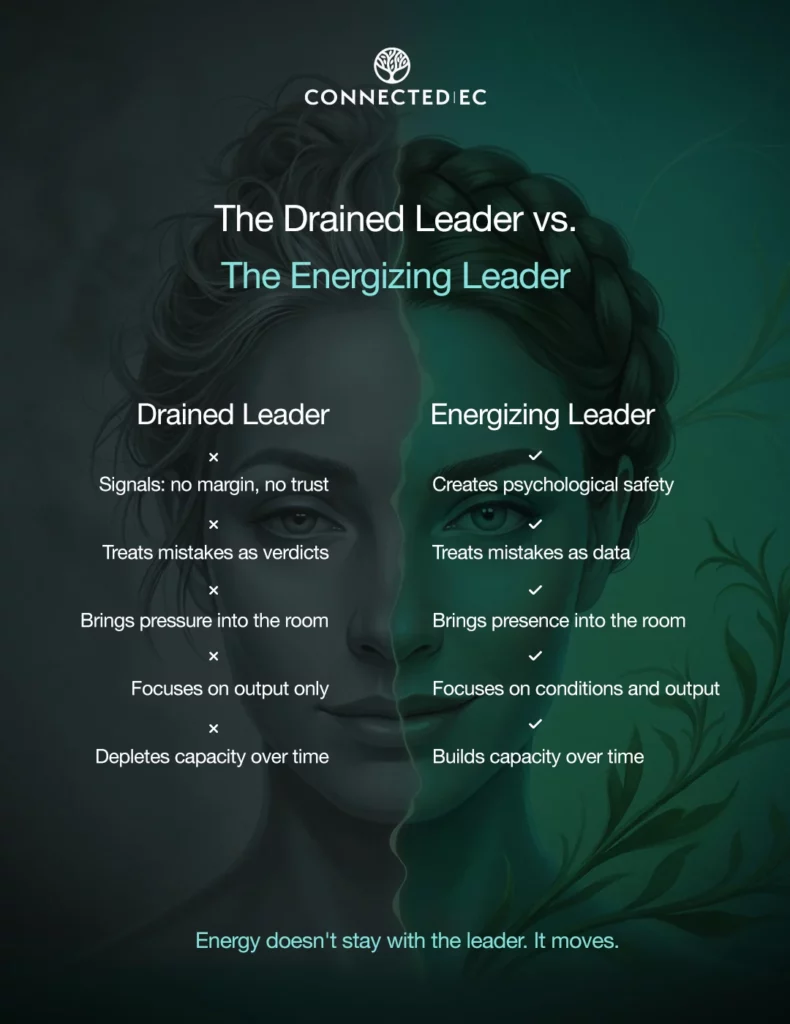
What happens inside the C-suite doesn’t stay there. It becomes the blueprint for the entire organization. Leaders often underestimate how visible they are. But every interaction, every decision, every inconsistency sends a signal about what matters.
When alignment is low at the top, it shows up quickly. Decisions slow down. Priorities compete. The organization starts operating with different versions of the truth. And over time, trust erodes.
Research consistently shows that low-trust environments reduce performance and limit cognitive capacity under pressure. People become more reactive, less collaborative, and less clear.
This is why connection, clarity, and communication matter so much. In my book Connected Culture, I describe these as part of the 5Cs Model, the conditions that shape how teams function and perform. They’re not soft skills. They’re the system that allows organizations to operate at their best.
How It Breaks Down Day to Day
In practice, these patterns rarely look dramatic. They show up in ways that feel reasonable in the moment, but costly over time.
Leaders default to functional thinking, advocating for their area instead of the enterprise. Silos form, even when no one intends them to.
Conversations that should happen directly get rerouted. People talk about each other instead of to each other. It feels safer, but it slowly erodes trust.
Under pressure, leaders step closer to execution. They stay involved to help, but end up creating bottlenecks and signaling a lack of trust.
Meetings fill with updates instead of decisions. Priorities stay fixed long after conditions change.
Each of these choices makes sense in isolation. Together, they fragment how the organization operates.
What Strong Teams Do Differently
High-performing C-suites don’t rely on a different set of rules. They operate from a different set of disciplines.
They see themselves as a first team, not a collection of functional leaders. Decisions are made in service of the enterprise, not individual areas.
They build structures that surface truth, even when it’s uncomfortable. They don’t rely on filtered information or assumptions.
And they treat connection as core work. Not something to get to later, but something that shapes how everything else functions.
There’s no checklist for this. These are ongoing choices.
And this is the part most leaders underestimate. Not the knowing, but the practice of it.
The space to step out of day-to-day execution, look at how you’re actually operating, and recalibrate in real time.
It’s something I see every time I’m in a room with leaders doing this work together. When you slow down enough to examine how you think, decide, and show up, the patterns become visible very quickly, and so does what needs to shift.
One Thing to Try This Week
In your next leadership team meeting, notice who’s advocating for their department and who’s thinking about the whole company.
Most C-suites have both happening at once, often in the same conversation, often without anyone naming it.
When you catch it, say it out loud: “Are we solving for a functional area here, or for the enterprise?”
That question, asked consistently, shifts something. Not because it’s profound, but because most teams never stop to ask it.
These aren’t problems you fix and move on from. They’re patterns you learn to see and name, over and over. The strongest leadership teams aren’t the ones without tension. They’re the ones who got honest about it.
That’s the real work.