When a CEO calls me because results are stalling, they usually want to talk about strategy. But within minutes, it becomes clear the issue isn’t strategy—it’s culture.
Decisions are slow. Meetings are political. Leaders are exhausted. The system isn’t broken because the plan is wrong; it’s broken because the people executing it are disconnected, unclear, or misaligned.
What if culture, not strategy, was the real constraint on performance?
At Connected EC, we’ve spent years turning that question into measurable data. The result is the 5Cs Framework—a psychometrically validated system that makes culture visible, quantifiable, and actionable. It exposes the hidden drivers that determine whether your teams move fast or stall, innovate or resist, stay or leave.
Culture Drives Results (You Just Can’t See It Yet)
Culture isn’t a vibe. It’s how work gets done. It’s how decisions are made, how information flows, how people recover and re-engage when things get hard. It’s the invisible infrastructure that determines execution speed, decision quality, and the energy your people bring to the table.
The problem is that most executives treat culture like a soft variable, something to “feel” rather than measure. That’s a costly blind spot.
When culture is unmanaged, it drains three critical performance currencies:
- Margin: inefficiency, rework, and decision drag quietly erode profits.
- Momentum: fear, silos, and lack of clarity slow innovation and adaptability.
- Morale: burnout and disengagement cause turnover and talent flight.
The 5Cs turn this invisible friction into data leaders can manage. It’s not about HR metrics or engagement surveys. It’s a system for operationalizing the human factors that drive business outcomes.
The 5Cs of Performance
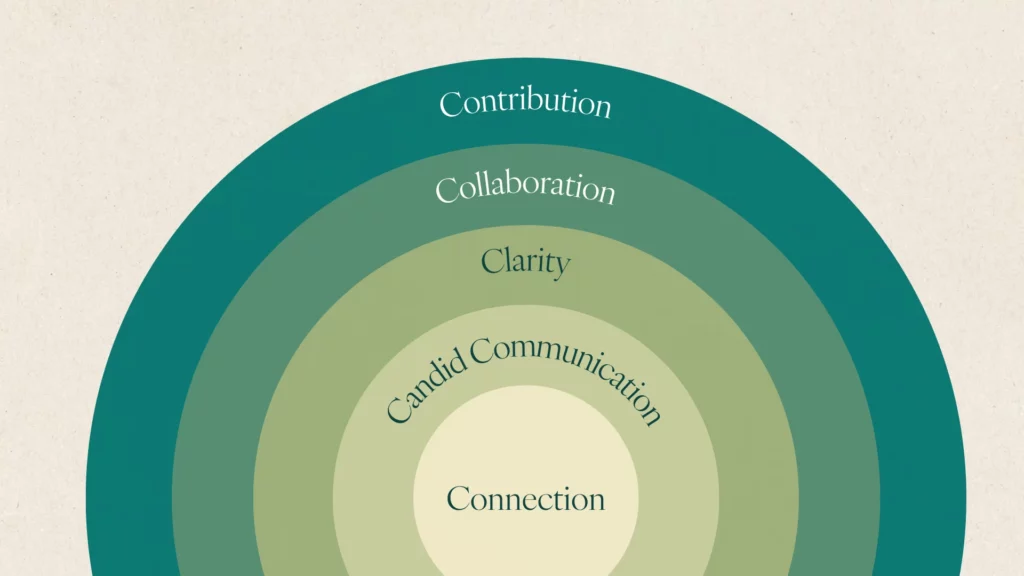
Every thriving culture and every high-performing team shares five core factors. Together, they form the 5Cs Framework, your organizational operating system for performance.
Connection — Quality of interpersonal and organizational bonds, grounded in trust and well-being. When trust and care are strong, teams become resilient and performance is sustainable. Metric link: satisfaction, retention, and well-being.
Candid Communication — Open, honest, constructive dialogue that surfaces truth early. Built on psychological safety, healthy conflict & feedback, transparency, and ideas meritocracy. Metric link: decision quality/speed, learning velocity, performance.
Clarity — Clear roles, goals, and processes that focus energy and cut ambiguity (the “hidden tax” on performance). Subfactors: roles & responsibilities, goals, processes. Metric link: cycle time, alignment, productivity.
Collaboration — Working together with shared accountability and excellence, reinforced by team support, accountability, and excellence norms. Metric link: cross-functional delivery, on-time project success, innovation throughput.
Contribution — Meaning, impact, and alignment—people feel their work matters and reflects core values, creates impact, supports meaning & mattering, and connects to shared vision & purpose. Metric link: engagement, quality outcomes, internal mobility/commitment.
When leaders measure culture through these five dimensions, they can finally see what fuels or hinders execution and manage it with the same discipline they apply to finance or operations.
From Insight to Action
The 5Cs aren’t just diagnostic, they’re operational. Executives use the 5Cs dashboard as a leading indicator of performance, not a lagging one.
Imagine sitting in a quarterly business review and, alongside financials, seeing a live view of your organization’s cultural energy:
- Which business units are aligned and accelerating.
- Where clarity or collaboration is breaking down.
- How connection and communication trends predict retention or innovation risk.
After years of restructuring, a Fortune 100 executive team struggled with burnout and disengagement. Through the 5Cs assessment, we discovered that while strategy alignment was strong, Connection and Candid Communication were breaking down. Leaders were avoiding tough conversations and operating in silos of exhaustion. We rebuilt their leadership rhythm around relational connection, starting meetings with trust, energy checks, and feedback loops. Within a quarter, well-being scores rose, candid feedback increased, and collaboration returned. As one leader said, “We started seeing each other as people again, not just roles.”
Culture became part of the operating rhythm, not an HR initiative, but an executive performance system.
The 5Cs convert something previously subjective into something you can quantify, monitor, and manage. They turn culture into infrastructure.
See Your Own Performance System
Culture is the ultimate performance system, whether you manage it or not. The question isn’t whether culture drives results. It’s whether you can see it soon enough to act.
If you want to understand where your organization’s energy is compounding, or leaking, the 5Cs can show you.
Request a Demo to see your organization’s 5Cs dashboard and uncover immediate opportunities to strengthen connection, accelerate clarity, and protect the energy that drives performance.