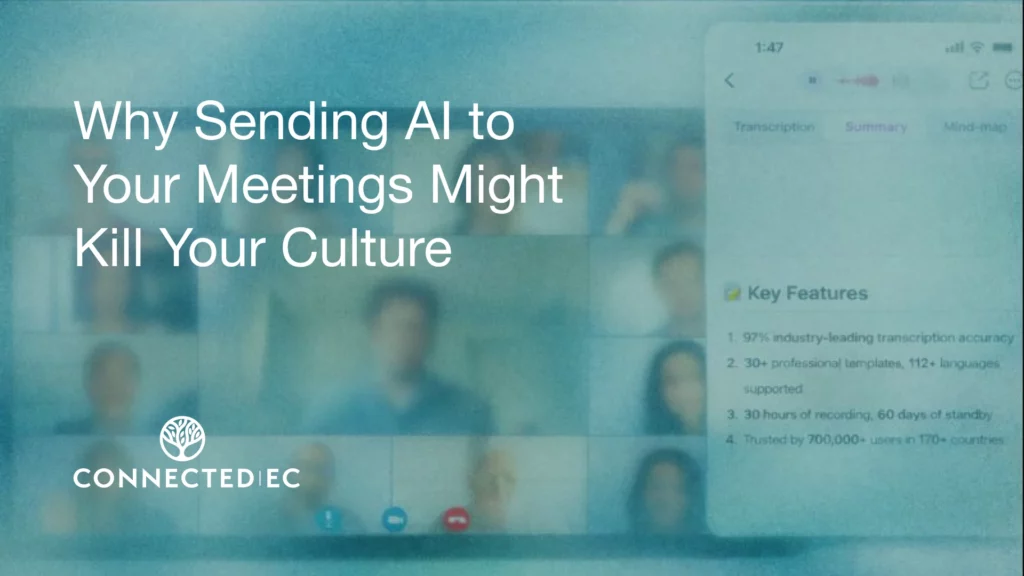
I keep getting asked the same question: Should AI agents attend meetings in place of people?
My answer surprises people: You’re asking the wrong question.
The real question isn’t whether AI can attend your meetings, it’s whether your meetings are worth attending in the first place.
The Real Problem Isn’t AI. It’s Meeting Culture.
Meeting culture in corporate America is a problem. No matter how much people try, meetings waste an extraordinary amount of time. So of course the first instinct when AI agents arrive is: Let’s send the AI instead.
But that instinct misses the point entirely.
Meeting culture in corporate America is a problem. No matter how much people try, meetings waste an extraordinary amount of time. So of course the first instinct when AI agents arrive is: Let’s send the AI instead.
But that instinct misses the point entirely.
When you send an agent in place of a human, you’re not solving the meeting problem, you’re breaking something foundational. You’re replacing human-to-human connection with efficiency theater. And in doing so, you’re eroding the very thing that makes teams work: relationships.
Research on meeting overload confirms this: too many low-value meetings increase stress and reduce perceived productivity, especially when they’re mostly information transfer. That’s a calendar design problem, not a job for AI stand-ins.
Here’s what I tell leaders: AI should help us create better meetings, not replace the humans in them.
What Most Companies Get Wrong
There’s a massive difference between meetings that are information exchanges and meetings that are relationship builders.AI can summarize. It can pull action items. It can take flawless notes. What it can’t do is read the room, sense tension, build trust, or repair a fraying relationship. It can’t tell you that someone checked out halfway through, or that the silence after a question wasn’t agreement, it was fear.
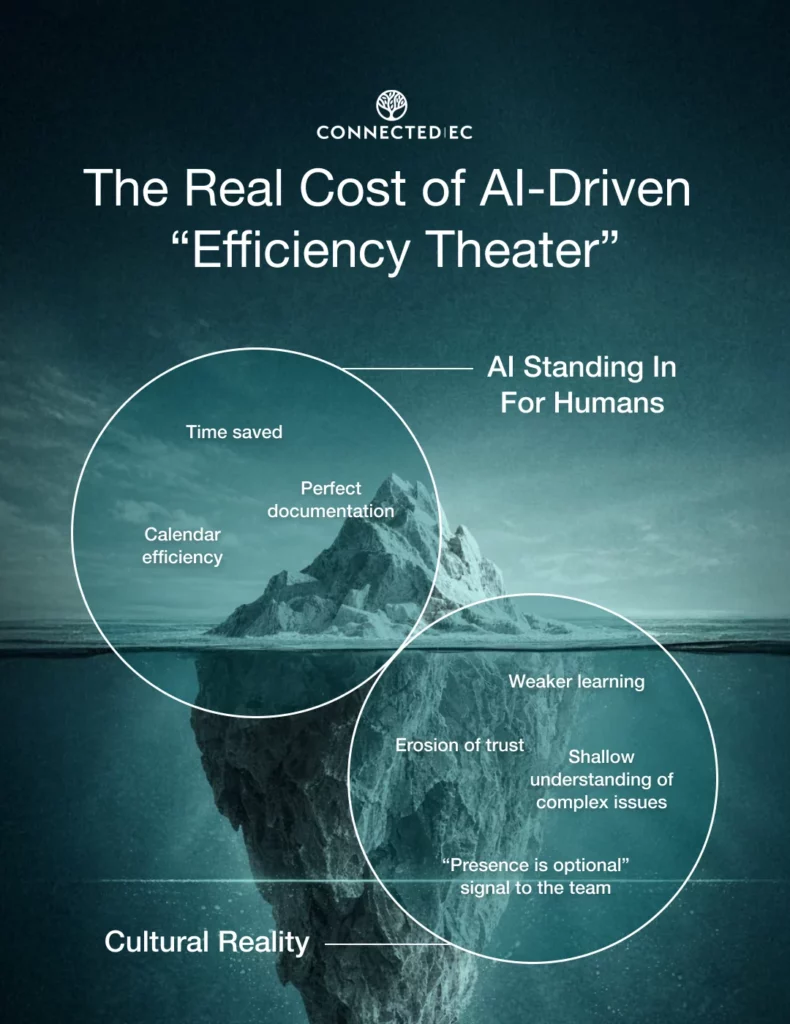
And here’s what neuroscience is starting to show: when people rely on a bot’s summary instead of participating live, they miss out on exactly the kind of focused, social thinking that creates learning and insight. Early work suggests that how we take in information changes how deeply we understand and remember it. When you skim an AI recap instead of being in the discussion, your brain does less active processing—which means weaker learning, weaker insight, and weaker connection to the work.
You don’t just lose time together. You lose depth.
If your meetings are just status updates, you don’t need a meeting. You need a Teams thread. But if your meetings are where alignment happens, where trust gets built, where people feel seen, then removing humans is a mistake you’ll pay for later.
The culture starts eroding the moment connection becomes optional.
Why This Matters More Than You Think
Here’s what I’m seeing in organizations right now: leaders talk about AI strategy before their people have internalized what the technology can actually do.
You can’t strategize what you haven’t internalized.
When executives send AI agents to meetings as a time-saver, they’re making a decision based on efficiency without understanding the cultural cost. And that cost is real: every time you choose the shortcut over the human interaction, you’re signaling what matters. You’re telling your team that presence is optional. That relationships are negotiable. That connection can be automated.
The data backs this up. Research shows that people’s trust in leadership and belief that their organization cares about their well-being hit new lows in 2024. Low-trust environments don’t just feel bad, they actively prevent teams from doing their best work. When trust drops, people move into survival mode. They create silos. They withhold information. They stop taking risks.
And here’s the part most leaders miss: you can’t build trust with an AI agent in your seat.
Trust requires vulnerability. It requires showing up when it’s inconvenient, staying in the room when it’s uncomfortable, and being present even when you’re overwhelmed. An AI can’t do that. It can never signal to your team: You matter enough for me to be here.
Long-term studies of relationships show that richer, face-to-face interactions are linked with better mental health and life satisfaction, while technology-dominated interaction patterns correlate with higher depressive symptoms. When “showing up” becomes optional, belonging and well-being are usually the first casualties.
This is why the meeting question is actually a culture question. The way you show up—or don’t—becomes the culture. What you tolerate, what you automate, and what you protect all send signals about what you actually value.
Where AI Actually Helps
I use AI every day. I have an agent trained in my voice, my thinking, my work. It expands my capacity in ways I couldn’t have imagined two years ago. But I’m deliberate about where I use it.
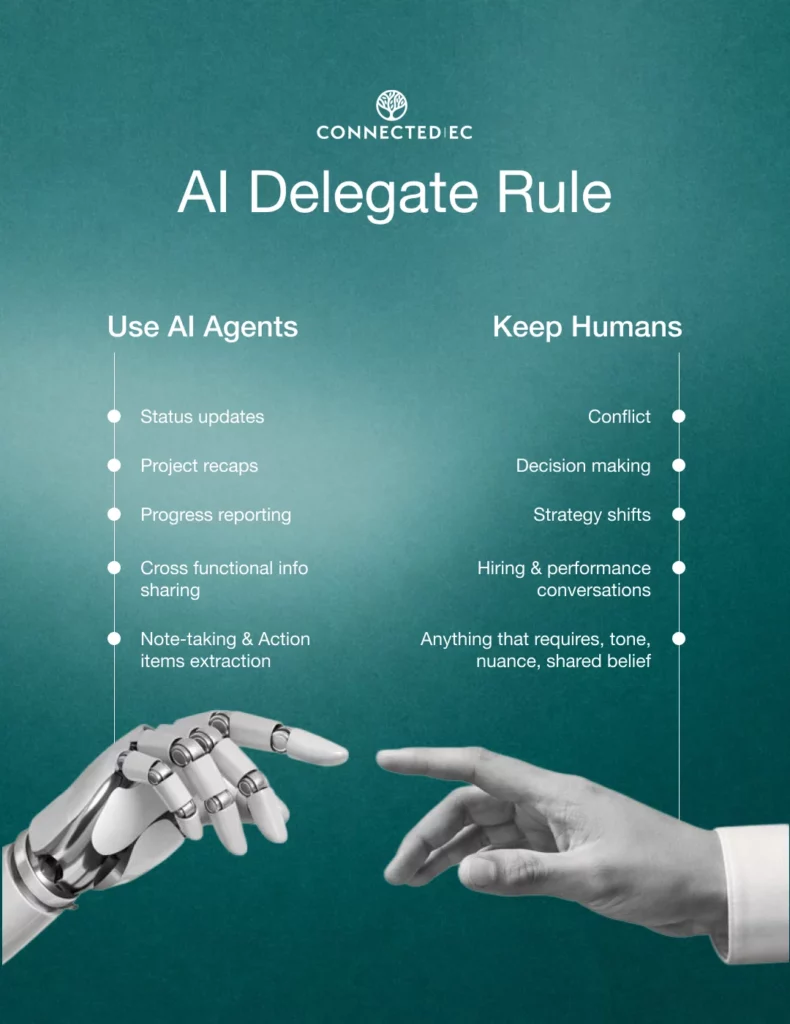
AI is brilliant at:
- Summarizing meeting notes so people can focus on the conversation, not frantic typing
- Drafting agendas based on past discussions
- Tracking action items across multiple sessions
- Preparing pre-reads so meetings start aligned, not confused
Human-AI collaboration research suggests the best outcomes come when AI handles the rote cognitive load—summaries, action tracking, pre-reads—so humans can invest more attention in each other. That’s the lever leaders should be pulling.
What AI can’t replace is presence. It can’t replace the executive who asks the hard question no one else will. It can’t replace the leader who notices someone struggling and follows up later. It can’t replace the moment when two people finally understand each other after weeks of misalignment.
AI should elevate the meeting experience, not eliminate the humans who make it matter.
The Shift That’s Needed
If you want better meetings, start here:
- Stop tolerating bad meeting hygiene. Every meeting should have a clear purpose. Is it a decision point? A brainstorm? A working session? If you can’t answer that, you don’t need the meeting.
- Use AI to support the humans, not replace them. Let AI handle the documentation. Let people handle the connection.
- Audit your calendar. How many meetings on your schedule this week are actually about information transfer? Those can be emails. The rest? Protect them fiercely.
The organizations that get this right won’t be the ones using AI to cut meeting time—they’ll be the ones using AI to make meetings worth showing up for.
One Action Step
This week, pick one recurring meeting on your calendar. Before the next session, answer this: What would be lost if no human attended this meeting?
- If the answer is “nothing,” cancel it or make it async.
- If the answer is “everything,” protect it, and make it count.
AI isn’t the enemy of good meetings. Bad meeting culture is.
The leaders who figure this out won’t just save time, they’ll build the kind of teams where people actually want to show up.
Jamie & the Connected EC Team