I was on a plane recently, sitting next to a senior Deloitte consultant. She asked what I do, and we got into a conversation about AI. As I explained how I work with CEOs on AI integration and culture, she paused mid-sip and put her drink down.
“I’ve never heard anyone talk about AI the way you just did,” she said. “Everyone I work with is focused on cost savings and headcount reduction.”
We spent the next 30 minutes unpacking why the way most organizations talk about AI is setting them up to fail.

The Language Problem
Here’s what I hear constantly from leadership teams:
- “We’re going to use AI to save so much money.”
- “This will help us do more with less.”
- “We can finally eliminate redundant roles.”
If you’re a leader saying these things, I need you to pause and think about what your team is actually hearing:
- My job is at risk.
- I’m expendable.
- I need to protect myself.
You’ve just sent every employee into survival mode. And when people are in survival mode, they don’t innovate. They don’t experiment. They don’t adopt new tools. They resist, protect, and wait for the threat to pass.
Here’s what neuroscience tells us: when we perceive a threat, especially to our livelihood, our brains shift into protection mode. We produce high levels of cortisol. We lose access to our prefrontal cortex, where complex thinking and creativity happen. We literally can’t think clearly or strategically when we’re afraid.
Language changes culture. It’s the foundation of culture. And right now, the language around AI is creating exactly the resistance organizations are trying to avoid.
The Reframe That Actually Works
In 25 years of walking into organizations, I’ve never, not once, heard someone say: “We have all the time and resources we need. We’re good.”
Never.
What I hear instead, every single time:
- “We’re maxed out.”
- “Everyone’s doing three jobs.”
- “We need to do more with less, and we’re already stretched.”
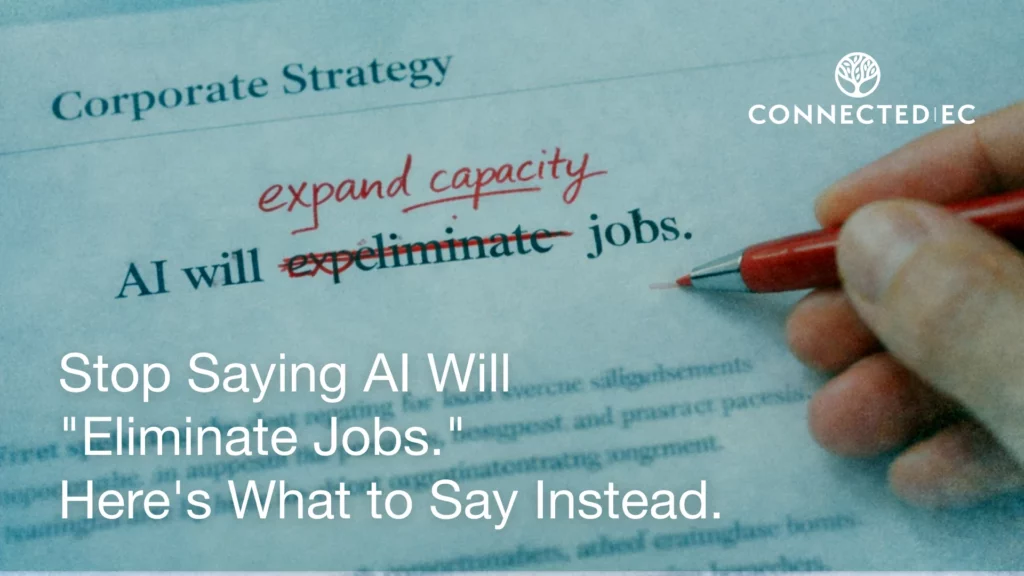
So here’s the reframe: AI isn’t here to eliminate you. It’s here to give you your capacity back.
This isn’t just semantics. It’s a fundamental shift in how you position the technology, and it changes everything about how people’s brains respond to it.
When we frame AI as a threat, we activate the amygdala, the fear center. When we frame it as support, as capacity-building, we keep people in the part of their brain where learning and adoption actually happen.
Instead of leading with cost-cutting, lead with this:
“What if this technology could take the repetitive, low-value work off your plate so you could focus on what actually requires your expertise, your judgment, and your relationships?”
That’s elevation, not elimination. And it’s the truth.
Why “Internalize Before You Strategize” Matters
Here’s the pattern I keep seeing: Organizations bring in a big consultancy to present a sweeping AI strategy. The deck is 60 slides. It shows how the entire industry will transform in 18 months. It’s overwhelming, abstract, and frankly, terrifying.
Then leadership expects people to get excited and start using AI.
It doesn’t work.
Cognitive scientists point out that insight isn’t just “information transfer,” it emerges from actually engaging with ideas, wrestling with ambiguity, and experiencing concepts firsthand. When we present AI as this massive, abstract transformation without letting people touch it, use it, and understand it through their own experience, we’re asking their brains to do something they’re not wired to do.
You can’t ask people to think strategically about something they don’t understand personally. You can’t ask them to embrace a tool they’ve never used. And you definitely can’t expect them to innovate with technology that’s been framed as a threat to their livelihood.
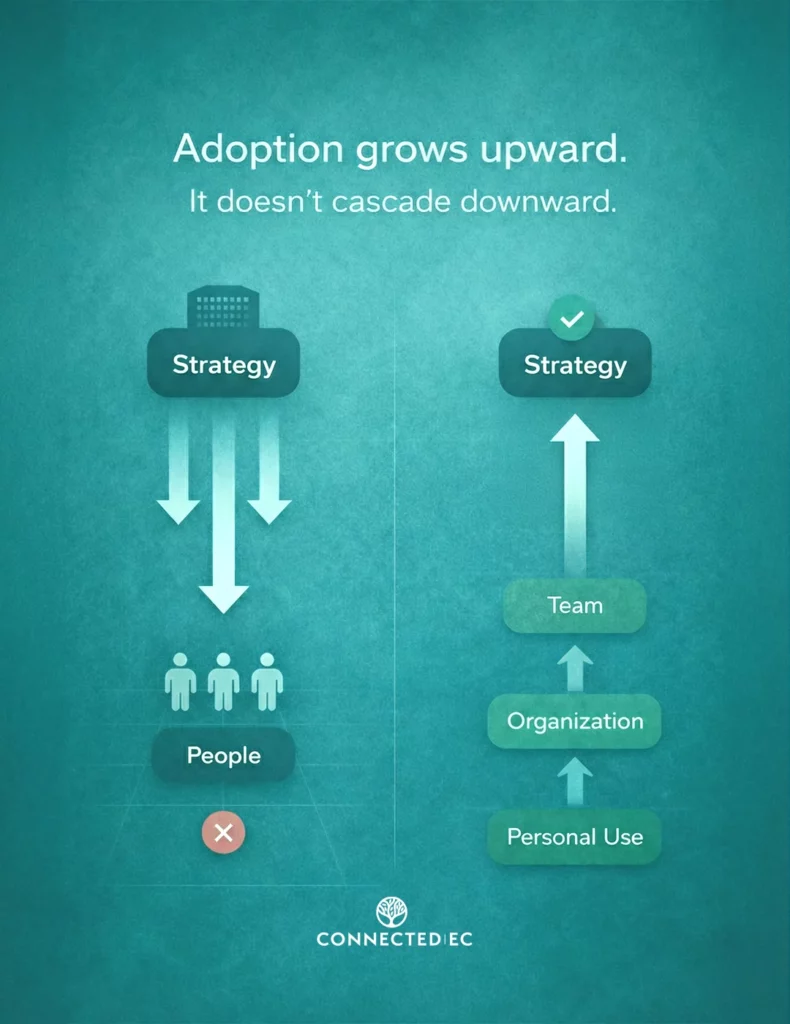
People need to internalize before they can strategize.
When I work with executives, the first thing I do is have them use my AI agent. I don’t talk about it, I ask them to interact with it. I show them what it can do for their own work, their own capacity, their own thinking.
And suddenly, the conversation shifts. They stop seeing AI as this abstract, scary thing and start seeing it as: Oh. This could actually help me.
Research on how we learn with AI suggests that hands-on experience changes not just what we know about the technology, but how we feel about it. When people use AI as a supporting tool for their own work first, they’re far more likely to see its potential across the organization.
That’s the unlock. That’s when adoption happens.
What Elevation Actually Looks Like
Let me give you a real example.
A client I work with needed to communicate urgency and clarity in a high-stakes message. She knew what she wanted to say, but refining the language would have taken hours she didn’t have.
Using an AI agent trained in her voice and priorities, she asked for three alternative openings that better conveyed urgency. Within minutes, she had strong options to choose from. She selected one, made a few small refinements, and moved forward with confidence.
What would have taken hours took minutes and the thinking stayed fully hers.
That’s elevation. She didn’t lose her ability to think or write. She gained capacity to do more of the work that only she can do, the strategic thinking, the relationship-building, the team coaching.
Human-AI collaboration research shows this pattern consistently: the best outcomes come when AI handles the rote cognitive load while humans invest more attention in judgment, creativity, and connection. We’re not being replaced—we’re being amplified.
This is what I mean when I say AI creates an army. It doesn’t replace you. It expands you.
And when leaders start talking about it this way, when they model it this way, the organization follows.

Why This Is a Culture Issue, Not a Tech Issue
Most companies treat AI as a technology initiative. They put it in the CTO’s organization.
They create a “SWAT team” to automate processes. They keep it siloed.
That’s a mistake.
AI isn’t a tech project. It’s a culture shift. And if you treat it like something that happens “over there,” you’ll never get org-wide adoption.
Research on trust in organizations shows that when employees believe leadership cares about their well-being, not just their output, engagement, innovation, and performance all increase. The opposite is also true: when people feel their organization views them as expendable, trust plummets. And we know from 2024 data that people’s trust in leadership and belief that their organization cares about their well-being hit new lows.
If you’re rolling out AI as a cost-cutting measure without addressing the human side, you’re compounding an already critical trust problem.
Here’s what works:
- Start with your top leaders. Get them using AI personally first. Not strategizing, using it. Give them tools, time, and permission to experiment.
- Change the language company-wide. Stop talking about elimination. Start talking about elevation. Make it a non-negotiable in all communications.
- Make it accessible, not elite. If only your ops team has access to AI tools, you’re reinforcing the fear. Give everyone access. Train everyone. Make it normal.
The organizations that figure this out won’t be the ones that saved the most money. They’ll be the ones that unlocked the most capacity in their people, and that’s where real competitive advantage lives.
The Reality Check
I’m not putting my head in the sand here. Yes, some roles will be displaced. Call centers are a real example. AI is already handling work that used to require hundreds of people.
But if that’s the only story we tell, we’re missing the bigger opportunity.
The bigger story is this: AI can take the soul-crushing, repetitive work off people’s plates and let them do the work that actually matters. The work that requires human judgment, creativity, and connection.
Studies on workplace well-being show that when people spend more time on meaningful work, the kind that uses their full capabilities, job satisfaction, engagement, and mental health all improve. AI gives us the chance to redesign work around what humans do best.
That’s not a threat. That’s a gift.
But only if leaders frame it that way from the start.
What to Do This Week
Here’s your move:
- Audit your AI language. Pull up the last three communications about AI: emails, presentations, town halls. How many times do you mention cost savings, efficiency, or “doing more with less”? How many times do you mention capacity, elevation, or empowerment?
- If it’s skewed toward the first list, rewrite it.
- Use AI yourself. If you haven’t personally used an AI tool this week, you’re not ready to talk strategy. Block 30 minutes, pick one task you’re dreading, and see what AI can do. Internalize it first.
- Change one conversation. The next time someone asks you about AI, don’t start with the business case. Start with: “What’s the most repetitive thing on your plate right now? Let’s see if AI can take that off.”
That’s how you shift from fear to possibility.
AI isn’t the enemy. The way we talk about it is.
The leaders who get this right won’t just adopt AI faster—they’ll build cultures where people feel expanded, not threatened. And that changes everything.