Every executive team I work with wrestles with the same tension: Am I too far above the work, or too deep in it?
Step back too far, and you lose touch with execution. Step in too far, and the bigger picture blurs. But that framing misses the real issue. The skill isn’t choosing one over the other. It’s learning when to shift between them, and doing so intentionally rather than reactively.
I call this altitude management. And it’s one of the most underdeveloped disciplines in executive leadership.
Leadership operates at three altitudes
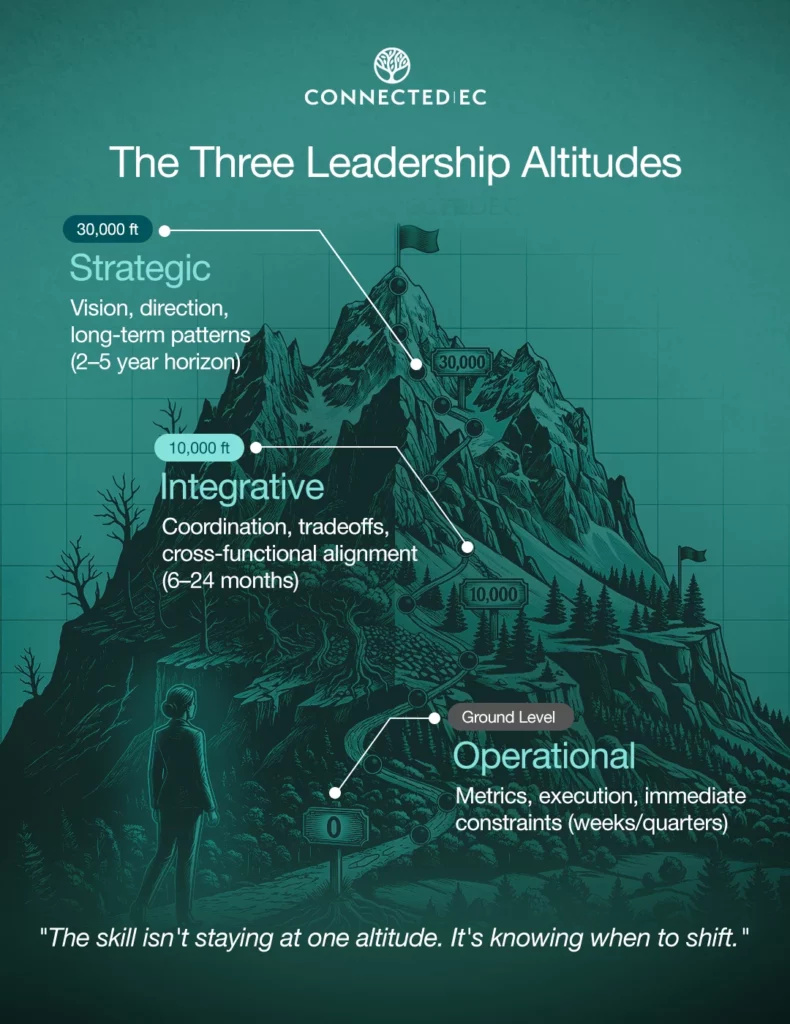
Most executive work happens across three levels of focus.
At 30,000 feet, the questions are about direction. Where are we going? What patterns are shaping the next several years? This is where leaders align resources and protect the long-term arc of the organization. But staying here too long makes vision feel abstract, and the people executing it start losing clarity around what actually matters now.
At 10,000 feet, strategy becomes operational reality. Leaders navigate tradeoffs, translate priorities into plans, and coordinate across functions. This is where strong teams spend much of their time. But the trap here is what I sometimes call planning theater, which means alignment conversations that stretch on while decisions slow down.
At ground level, the focus is immediate. Metrics, friction, the real constraints teams face daily. This altitude builds credibility and shows people you understand the work. But staying here too long leads to micromanagement, local optimization, and exhaustion.
Each altitude reveals something different. The discipline is knowing when to move between them.
The leadership blindspot
In theory, shifting altitude sounds like a strategic choice. In practice, it’s often emotional.
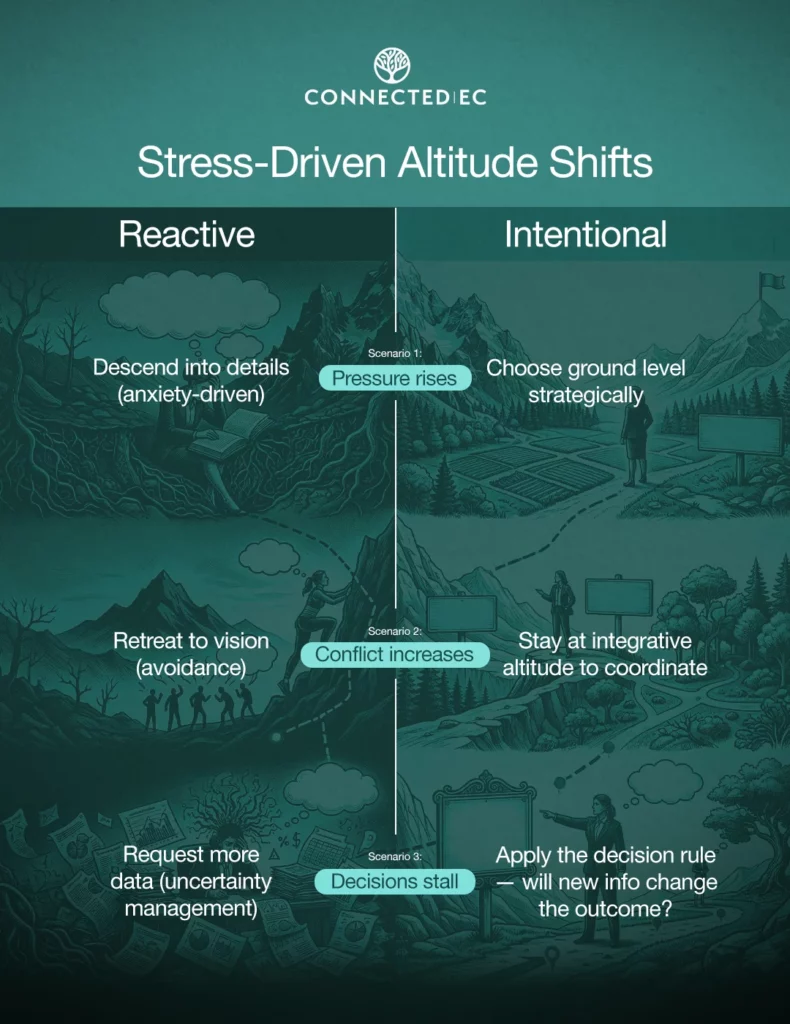
When results dip or pressure rises, leaders instinctively descend into the details. They review metrics more closely, involve themselves in operational decisions, and move closer to the work. It feels productive. It feels responsible. But it’s frequently a response to anxiety, not judgment.
The opposite pattern is equally common. When conflict increases or the work gets messy, leaders retreat upward. The conversation shifts to vision, long-term direction, and abstract strategy. Again, understandable. But not always intentional.
Neuroscience supports this. When we feel threatened or uncertain, cortisol rises and we shift into reactive mode: fight, flight, or freeze. We lose access to the prefrontal cortex, where our clearest strategic thinking lives. As Paul Zak’s research on the neuroscience of trust found, high-stress, low-trust environments reduce our cognitive capacity and push us toward short-term, self-protective behavior. Altitude shifts under pressure are often the nervous system making leadership decisions for us.
Where this breaks down inside teams
This dynamic gets most visible when executive team members are operating from different altitudes simultaneously, and don’t realize it.
One leader is discussing long-term positioning. Another is focused on what’s breaking on the ground. A third is trying to coordinate across functions. Each perspective is valid. But when these altitudes aren’t named, conversations drift. People aren’t disagreeing about direction, they’re talking past each other from entirely different vantage points.
I see this constantly. Strategy leaders talk about vision. Operational leaders talk about constraints. And the people in the middle carry the burden of translating between them. Decisions slow down. Frustration builds. Collaboration becomes harder than it needs to be.
This is fundamentally a Clarity problem. In my book, where I introduce the 5Cs Model, I explain that clarity means knowing your role, your priorities, and how decisions get made. It is one of the most overlooked drivers of team performance. When teams don’t have a shared understanding of what altitude this conversation requires, ambiguity creeps in and the work stalls. As I often share with leaders: your team can’t hit a target they can’t see.
When to gather data, and when to decide
Altitude also shapes how teams handle decisions. From a strategic altitude, leaders want more context, more analysis. From the ground, the pressure is to move now.
Neither instinct is wrong. But problems emerge when teams can’t agree on when to shift from analysis to action.
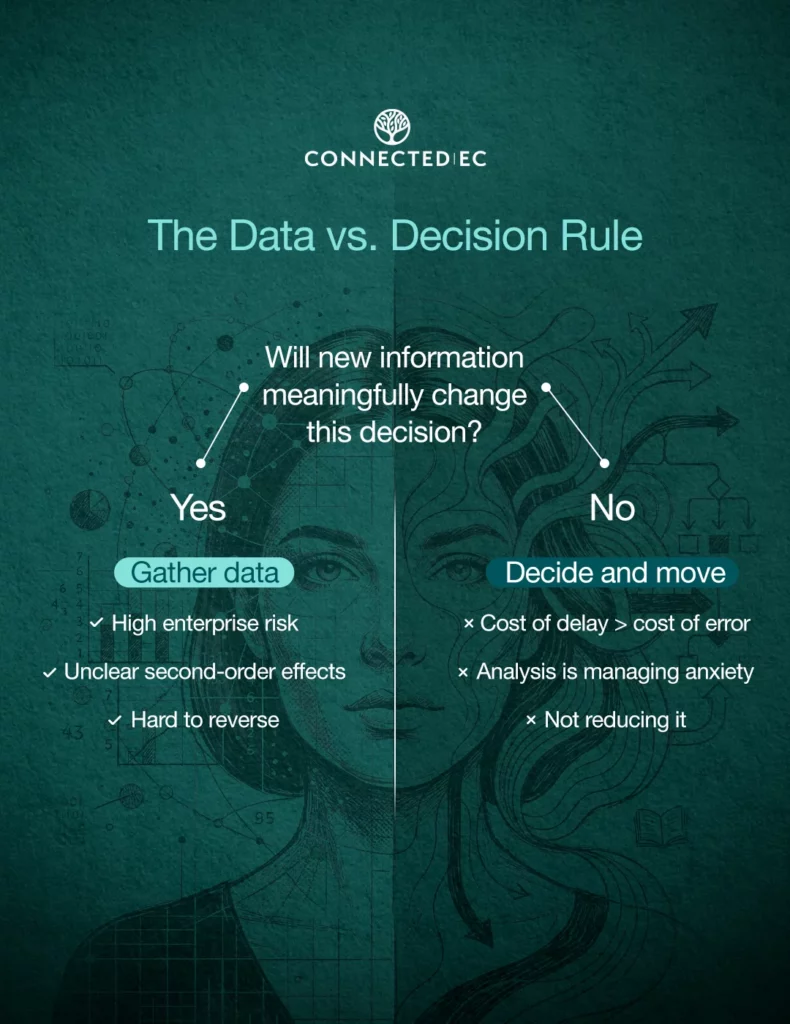
A simple rule helps: If new information would meaningfully change the decision, gather it. If it won’t, decide. Some decisions warrant slowing down, high enterprise risk, unclear second-order effects, difficult to reverse. Others just need movement. When additional analysis becomes a way of managing uncertainty rather than reducing it, the team needs to act.
One move to try this week
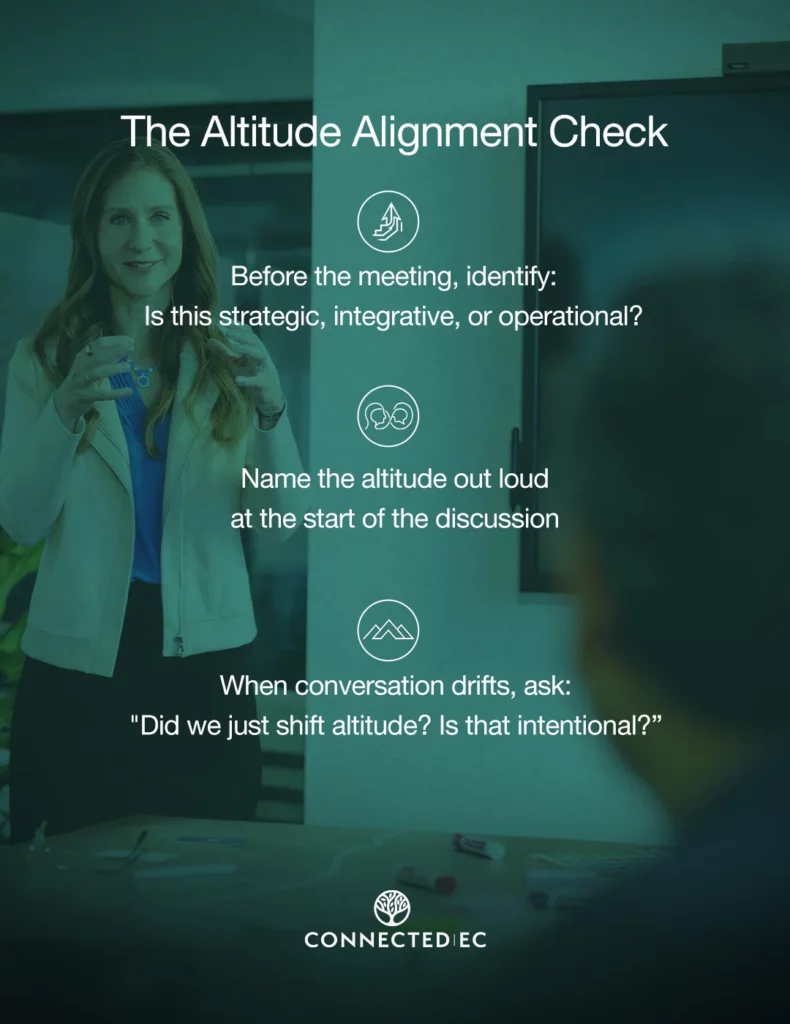
Before your next leadership meeting, ask one question: What altitude should we be at for this conversation?
Is this a strategic issue that needs long-range perspective? A coordination challenge across teams? Or an operational problem that requires precision close to the work?
Name it at the start. You’ll be surprised how much it changes the quality of the discussion, and how much less time the team spends talking past each other.
Over time, this becomes a shared language. And shared language is one of the most powerful tools for building culture.
Altitude isn’t a personality trait. It’s a discipline. And the leaders who develop it don’t just make better decisions, they create the conditions for everyone around them to do the same.
— Jamie