There’s a moment I see often in leadership teams. The calendar is full, the meetings are constant, and yet the work doesn’t seem to be moving as quickly as it should.
The conclusion feels obvious: there’s just not enough time. Too much to do, not enough hours to do it.
But that belief misses something important.
I’ve worked with leaders who have just as much on their plate, and yet their teams move faster with less friction. The difference isn’t time.
It’s how many decisions are still sitting unresolved.

The Hidden Cost of Unmade Decisions
What I see in many leadership teams isn’t just workload pressure. It’s decision accumulation.
I call this decision debt.
Decision debt is made up of three things: decisions that haven’t been made, decisions that have been delayed, and decisions that were made but never clearly communicated. Each one stays open in the system.
And open decisions don’t sit quietly. They take up cognitive space. They get revisited in multiple meetings. Teams pause, waiting for clarity, or move forward with assumptions that may not hold.
Over time, this creates drag.
I often see the same issue surface across three or four meetings, not because the team lacks capability, but because the decision hasn’t been closed. What feels like progress is often just repetition.
Every “we’ll revisit this” doesn’t save time. It compounds cost.
The challenge is that decision debt is mostly invisible. Unlike tasks or projects, it isn’t tracked, but it shapes how quickly everything else moves.
When Thoughtfulness Turns Into Delay
Most leaders don’t see this as a problem. It feels like good judgment.
“We’re being thoughtful.”
“We need more data.”
“Let’s not rush this.”
And sometimes, that’s true. Some decisions do require time and careful consideration.
But what I see just as often is something else. Delay that isn’t driven by strategy, but by discomfort. The risk of being wrong. The pressure of making a call without perfect information.
So the decision stays open.
The system doesn’t pause when that happens. Work continues, just without clarity. Teams hesitate or move forward with assumptions. The same topics get re-litigated in different rooms. Momentum slows, not dramatically, but quietly and slowly.
Delaying a decision doesn’t reduce complexity. It redistributes it. And in many cases, decision debt is less about analysis and more about avoidance.
How Decision Delay Becomes Culture
This isn’t just an individual productivity issue. It scales into the system.
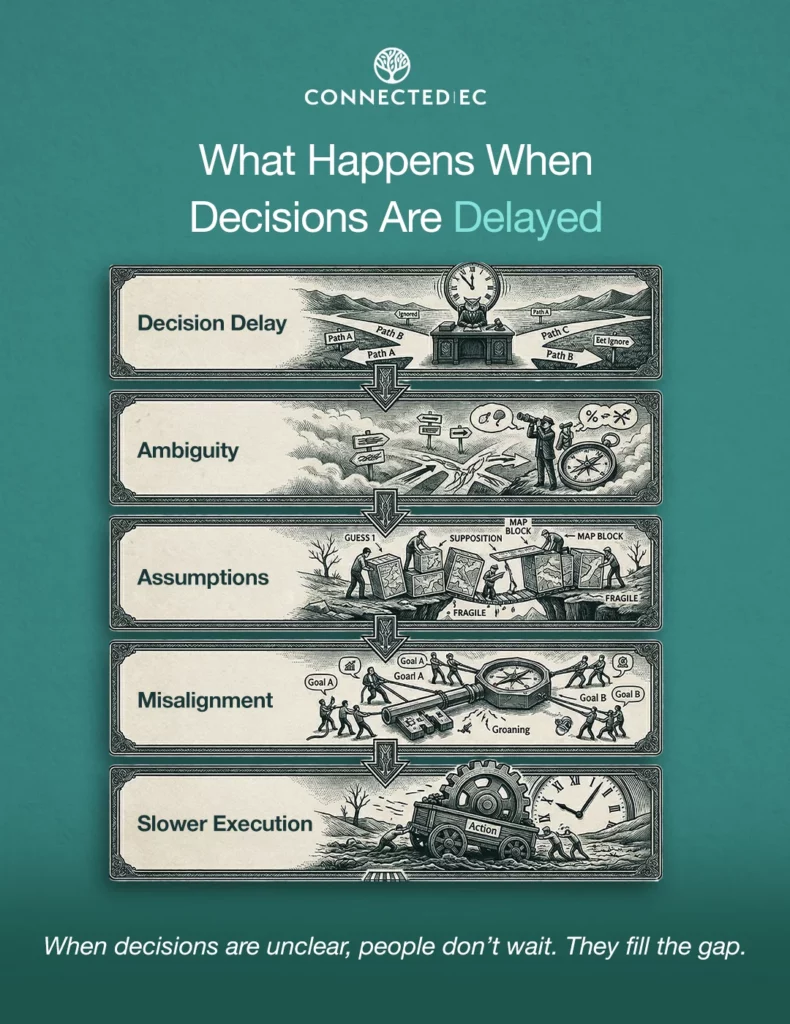
When decisions are consistently delayed, teams begin to adjust. They stop expecting clarity to come from the top. Instead, they fill in the gaps themselves.
Assumptions replace alignment. Work moves, but not always in the same direction. Silos start to form, not because people want them, but because they don’t have a shared decision to anchor to.
Over time, ambiguity becomes the norm.
When decisions are unclear, people don’t wait. They fill the gap.
Research on cognitive load shows that unresolved choices consume mental capacity. In organizations, that shows up as slower decision-making, reduced focus, and lower energy.
Clarity is one of the core drivers of high-performing teams. And clarity doesn’t come from more discussion. It comes from decisions that are made, owned, and understood.
It’s one of the reasons Clarity is a key factor of the 5Cs Model in my book Connected Culture. When decision-making is clear, everything else moves. When it’s not, everything else stalls.
The Good Intention Trap
This pattern doesn’t come from poor leadership. It usually comes from good intentions.
Leaders want alignment, so they extend the discussion. They ask for more data to be thorough. They hold space to be inclusive. They avoid pushing a hard decision too quickly.
All of that makes sense.
But over time, it creates a different outcome. Meetings multiply. The same topics get revisited. Execution slows. High performers start to feel the friction of not being able to move.
And leaders find themselves pulled deeper into the details, trying to compensate for the lack of progress. The effort to be thoughtful often turns into a pattern of not deciding.
Not because leaders don’t care, but because the system quietly rewards delay over clarity.
What Strong Decision Discipline Looks Like
The shift isn’t about moving faster for the sake of it. It’s about becoming more intentional about how decisions get made.
Not every decision requires perfect data. In many cases, speed and clarity create more value than precision. And decision-making is not a group activity by default. It’s a leadership responsibility.
A simple way to think about it: some decisions carry high risk and are difficult to reverse. Those deserve time.
But most decisions are reversible. They benefit from movement.
The goal isn’t to get every decision right. It’s to make decisions that are clear and timely enough to move the system forward.
Clarity beats certainty in almost every operating environment.
And when decisions are closed, cognitive space opens up. Leaders regain focus. Teams regain momentum.

One Decision to Make This Week
Before your next leadership meeting, pause and ask yourself one question: What decision am I revisiting that hasn’t improved with time?
If additional data will meaningfully change the outcome, define exactly what’s missing. If it won’t, decide and move.
Leadership isn’t just about thinking through problems. It’s about closing them. Your team doesn’t just need your effort. They need your clarity.
Decisions create momentum. And over time, clarity builds trust.