Most organizations are still trying to solve engagement the same way: better communication, stronger managers, clearer goals, more leadership training. And yet engagement continues to fall.
I’ve coached CEOs and executive teams for decades, and what strikes me is how often leaders focus on visible performance systems while overlooking the day-to-day experience of working inside them.
Because employees don’t only respond to strategy. They respond to how leadership feels in practice. What happens in meetings, in moments of pressure, and in everyday interactions that either expand their capacity or slowly diminish it.
That’s the part many organizations still underestimate.
The Leaders People Don’t Burn Out Around
In our recent research on leadership and engagement, one pattern became remarkably clear: the leaders who create thriving teams are not necessarily the most charismatic, visionary, or outwardly inspiring.
They are the leaders who consistently leave people feeling more capable after an interaction than they felt before it.
This is called positively energizing leadership. Not performative positivity. Not constant optimism. And not the kind of leadership that relies on intensity or force of personality.
It’s much quieter than that.
I’ve seen it repeatedly in executive teams and organizations with strong cultures. The leaders people trust most are often described with the same word: energizing.
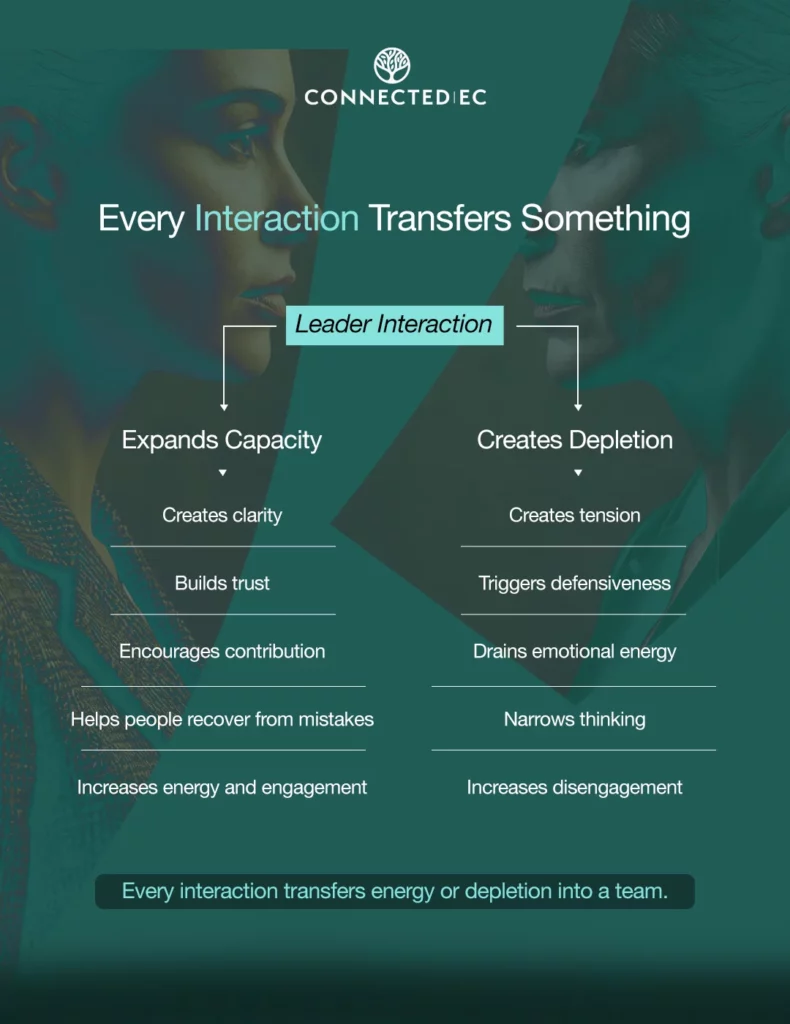
They create clarity in moments of pressure. They make people feel valued. They help teams recover quickly from mistakes instead of collapsing into blame or exhaustion.
The best leaders don’t just direct energy through an organization. They generate it.
What Employees Carry Away From an Interaction
Most leadership development still prioritizes visible leadership skills: strategic thinking, executive presence, communication frameworks, decision-making. And those things absolutely matter.
But they are often not what employees remember most.
Employees remember how a leader responds when something goes wrong. Whether they felt heard in a conversation. Whether a meeting created clarity or tension. Whether they left an interaction feeling steadier and more capable, or more drained than before.
This is where many leadership conversations become incomplete.
Competence matters. Strategy matters. But leadership also has a relational effect that organizations often fail to measure well.
Every interaction transfers something into a team. Energy or depletion. Expansion or contraction.
Most leaders are doing one or the other unconsciously.
Why Relational Energy Is Becoming a Strategic Advantage
Relational energy matters because the emotional tone leaders create doesn’t stay contained within individual interactions. It shapes trust, collaboration, resilience, and ultimately the culture people work inside every day.
Gallup’s latest research found that global employee engagement has fallen to 20%, with the sharpest decline happening among managers themselves. Around the same time, our research on positively energizing leadership found that leaders who generate relational energy consistently predicted engagement and well-being more strongly than traditional leadership models alone.
That finding becomes even more important in today’s work environment.
In hybrid and distributed teams, people experience leadership through screens, rushed meetings, and fragmented communication. Small interactions carry more weight now. And as AI automates more routine work, the human side of leadership becomes increasingly valuable, not less.
Judgment. Trust. Emotional regulation. The ability to create clarity and steadiness under pressure.
Those are deeply relational skills. And the leaders who can generate that kind of energy inside a team will have a growing advantage in the years ahead.

How Well-Intentioned Leadership Starts Draining Teams
Most draining leadership doesn’t come from bad intent. It comes from leaders operating under constant pressure without realizing what that pressure is transferring into the people around them.
I’ve seen many leaders equate responsiveness with support. Constant availability with commitment. Pressure with high performance. Efficiency with effectiveness.
But over time, those patterns can quietly create cultures that feel emotionally compressed and reactive.
Back-to-back meetings leave no space for reflection or recovery. Check-ins become purely transactional. Leaders are physically present but psychologically elsewhere, already thinking about the next decision, the next fire, the next conversation.
Even performance discussions can become so focused on output that people stop feeling seen inside the process.
In hybrid environments, this becomes even easier to miss. Communication gets flatter. Interactions become more functional. And leaders often underestimate how quickly emotional depletion travels through a team.
The issue usually isn’t capability. It’s unexamined depletion.
And teams almost always feel it before leaders do.

The Leaders Who Create Sustainable Performance
The strongest leaders aren’t necessarily the ones who maintain constant intensity. More often, they’re the ones who create conditions where people can continue performing well without becoming depleted in the process.
That requires a different kind of leadership awareness.
The leaders who generate trust and engagement tend to create clarity without creating panic. They challenge people without emotionally exhausting them. They stay grounded during uncertainty, which allows teams to stay more regulated and focused under pressure.
They also understand something many organizations overlook: people recover faster when they feel psychologically safe inside a mistake. Not protected from accountability, but supported enough to keep contributing with confidence.
None of this is formulaic. It’s relational judgment. The ability to notice what a team needs in a given moment and respond intentionally rather than reactively.
And in many ways, that’s the leadership skill that matters most now.

Your One Reflection This Week
Before your next important meeting or conversation, pause for a moment and ask yourself:
Will people leave this interaction with more energy or less?
If the answer is less, don’t ignore it. Slow down. Reconsider the tone, urgency, or pressure you may be carrying into the room before it gets transferred into the team.
Leadership is not only about direction, execution, and performance management. It’s also about emotional transfer. Relational influence. The unseen ways leaders shape the experience of work for the people around them.
The leaders who strengthen cultures over time are rarely the ones creating the most intensity. More often, they’re the ones who consistently leave people feeling steadier, clearer, and more capable after the interaction than before.
And in many ways, that’s what people are really responding to when they say a leader is energizing.

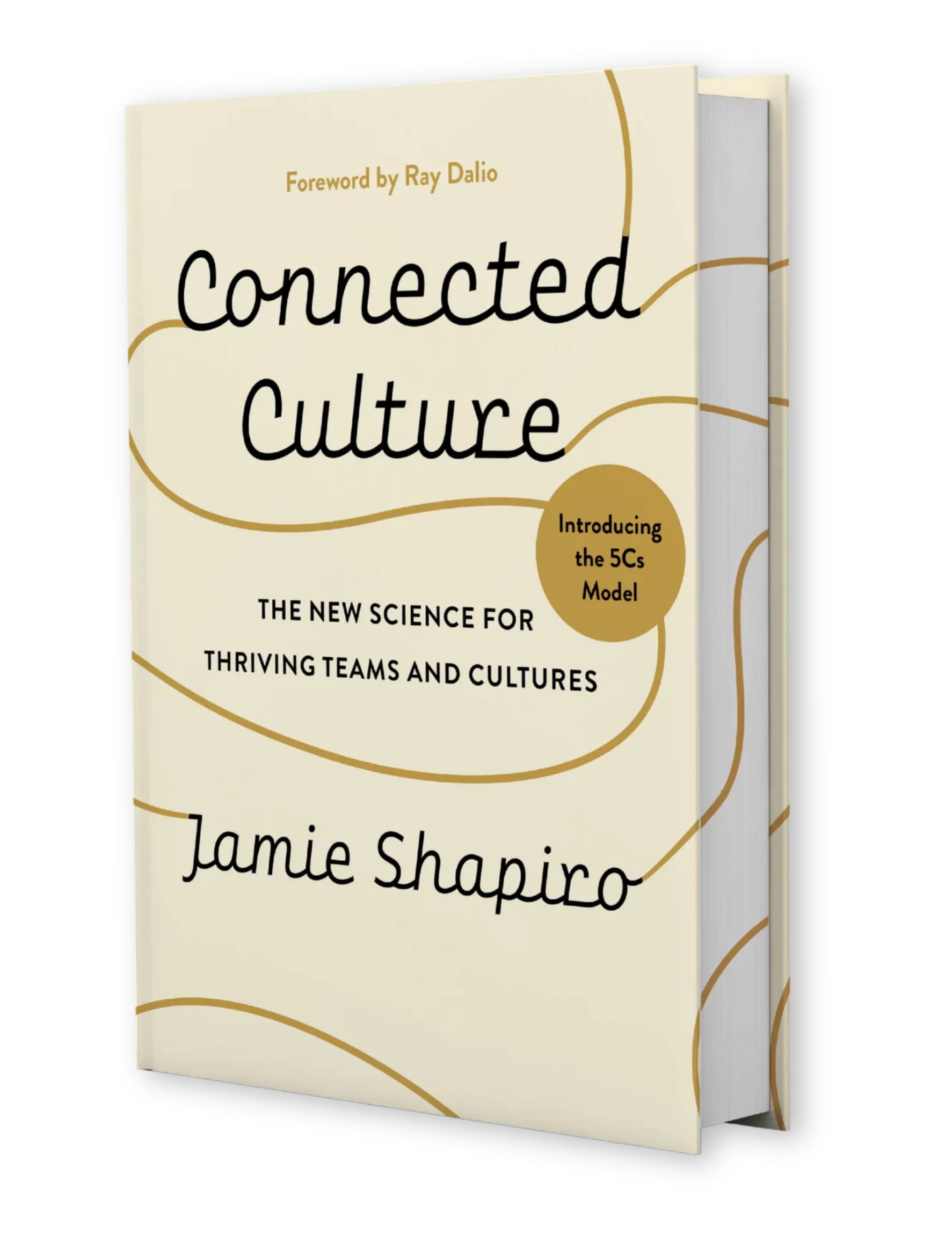
P.S. Everything in this newsletter is a thread I pull much further in my new book, Connected Culture. Check it out here.