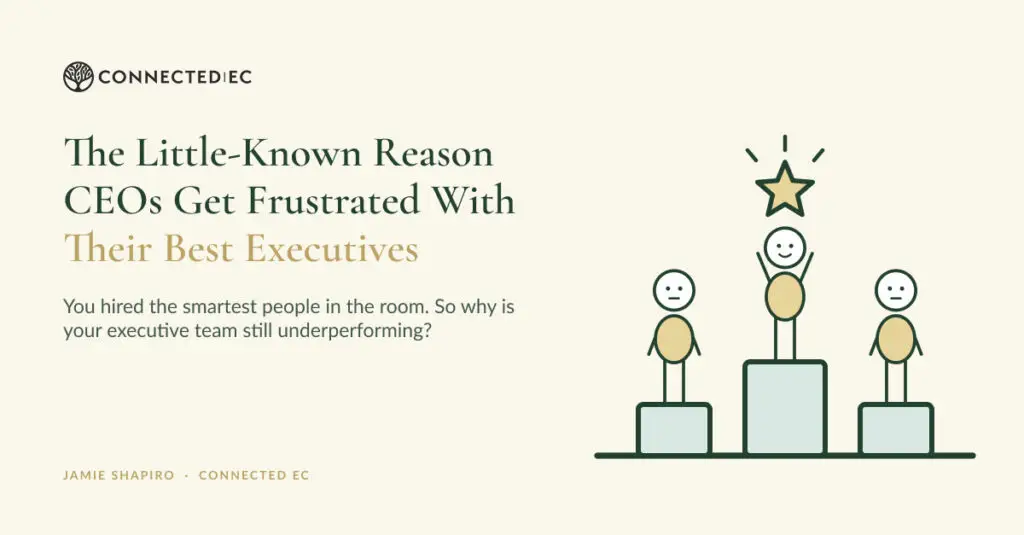
You assembled a leadership team of your most capable people. Each one is excellent. And somehow, together, they add up to less than they should. Decisions take too long. Good ideas get quietly resisted. Everyone defends their own patch. You can see the talent in the room, and you can’t seem to get it to work as one thing. You can’t just order people to collaborate, and that is the part that wears on you.
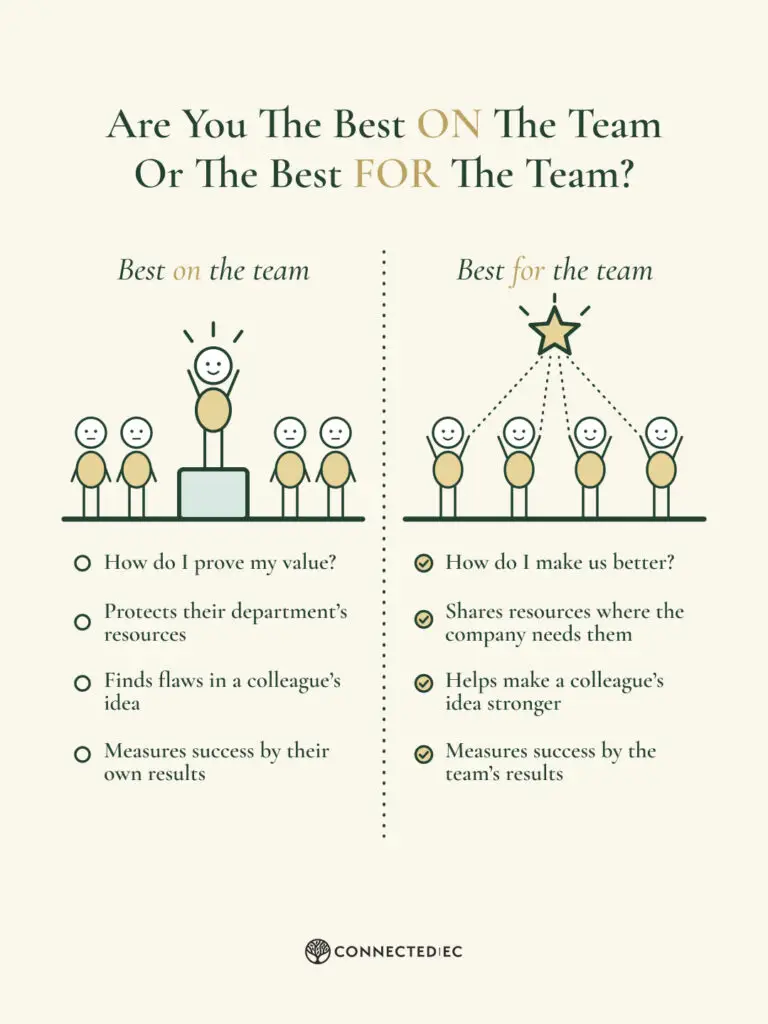
I was talking with a Chief People Officer recently and she said something I haven’t stopped thinking about. “People are trying to be the best on the team instead of the best for the team.” In one sentence, she named the thing most leaders feel and can’t quite put their finger on.
It isn’t a character flaw. It’s the system that made them
Your best executives didn’t reach the top by blending into the group. They got there by standing out. Deep expertise, visible results, problems only they could solve. For their entire careers, the message was consistent: be excellent, be indispensable, be the person people notice.
Then they join the executive team, and the definition of excellence quietly changes. Being the strongest functional leader in the room is no longer the goal. But nobody announces the change, so they keep playing the game that got them there.
The brain is wired to keep score
They’re also working against their own wiring. Neuroscientists at the University of Bonn found that the brain’s reward center responds not to what you gain in absolute terms, but to what you gain relative to the person next to you. The same win registers as more or less rewarding depending on how you stack up against a peer. We are built to compare, often below conscious awareness.
Put a group of high performers around a table and that comparison runs constantly. The CFO defends finance instead of helping solve the commercial problem. A leader listens to a colleague’s strong idea while silently calculating what saying yes might cost them in budget, headcount, or influence. The meeting looks collaborative from the outside, while inside it, everyone is still keeping score.
It gets sharper at the top, because each person walks in representing something enormous: a function, a region, thousands of employees, hundreds of millions of dollars. Those stakes are real. They also make it dangerously easy to confuse representing your part of the enterprise with leading the enterprise.
Talent alone won’t save the team
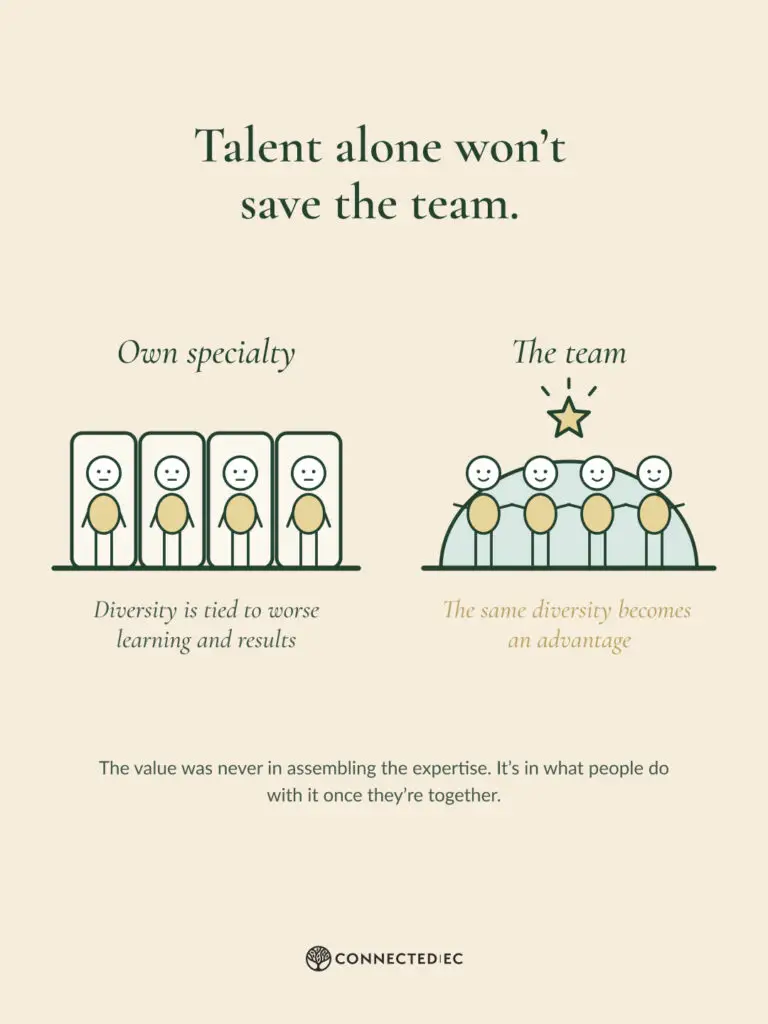
If this sounds like your leadership team, the research helps explain why. A study of multidisciplinary teams found that assembling diverse expertise did not improve performance on its own. When members identified mainly with their own specialty, that diversity was actually tied to worse learning and results. Only when people identified with the team did the same diversity become an advantage.
Sit with what that means. You can build the most talented team in your industry and still underperform if everyone’s primary loyalty is to their own piece of it. The value was never in assembling the expertise. It’s in what people do with it once they’re together.
Being the best on the team asks, “How can my expertise prove my value?” Being the best for the team asks, “How can my expertise make all of us better?” Those are completely different orientations, and they produce completely different meetings.
It might not look like the star
Being best for the team also changes what high performance looks like. The most valuable person in a meeting often isn’t the one with the breakthrough idea. It’s the one who asks the question that helps someone else reach it. The executive who gives up budget because another unit has a greater strategic need. The leader who strengthens a colleague’s idea instead of hunting for the flaw that makes their own look better. The one willing to say, “This is bad for my function, but I think it’s right for the company.”
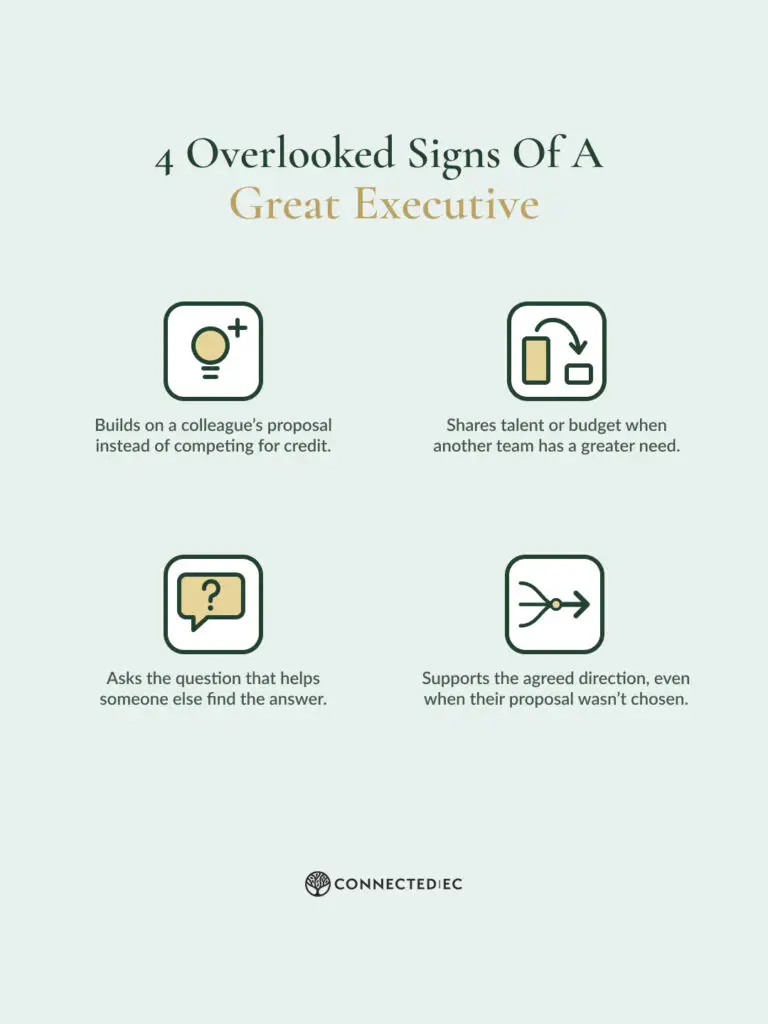
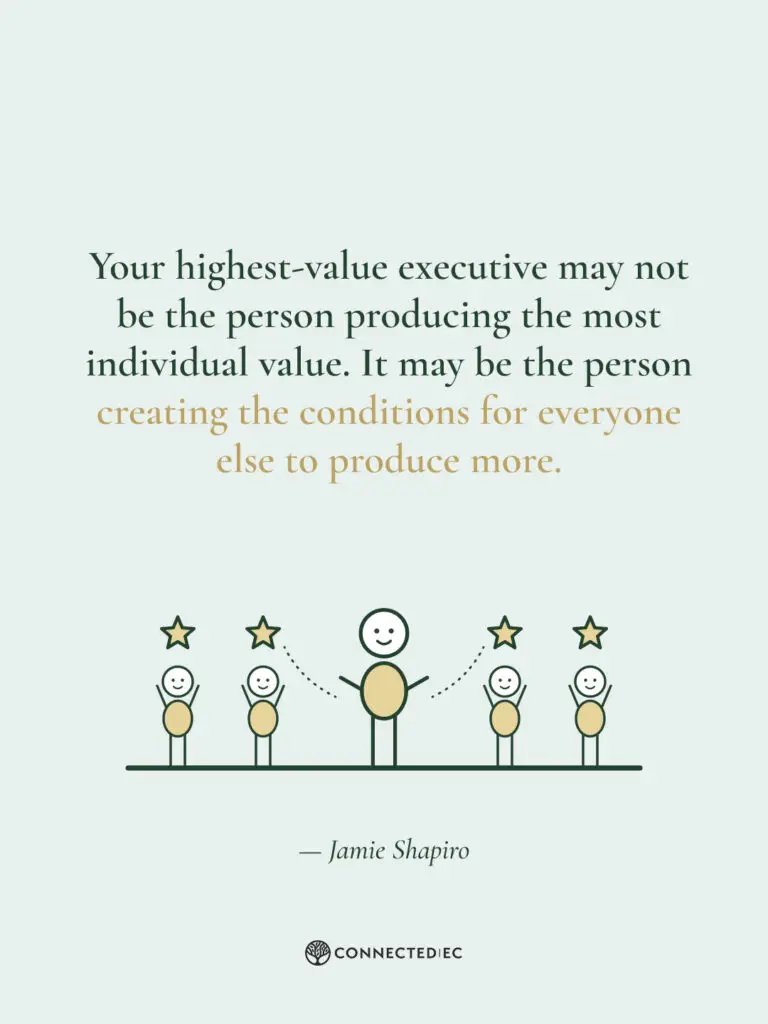
Those moves are easy to overlook, because most of our systems still celebrate visible individual accomplishment. So maybe the definition of a star needs to widen. Your highest-value executive may not be the person producing the most individual value. It may be the person creating the conditions for everyone else to produce more.
You create the game they play
This is the part only you can change. You can’t ask a team to think enterprise-first while rewarding everyone for winning inside their own silo. People read what gets celebrated, promoted, funded, and discussed in reviews. If every signal says “deliver your number,” no one should be surprised when leaders optimize for their number.
So change the questions. In talent reviews, ask who makes the people around them better. Who shares talent instead of hoarding it. Who argues hard for their view and then fully backs the team’s decision once it’s made. And pay close attention when resources are tight, because enterprise mindset is easy when everyone wins. You find out who’s truly best for the team the moment someone has to lose something so the whole company can gain.
None of this is asking your best people to be less ambitious. Keep the ambition, keep the standards, keep the drive to do extraordinary work. Just make the target bigger. At the highest level, excellence stops being only what you personally accomplish. It becomes what’s possible around you because you are there.
Helping executive teams make exactly this shift, from best on the team to best for the team, is the work I do inside companies. If it’s the shift you need, let’s talk.
So the question worth asking your most talented leaders isn’t whether they’re among the best people on the team. It’s harder than that: are they using everything that makes them great to be great for the team?
— Jamie