You’re not burned out because you work too hard.
You’re burned out because you’ve been spending energy without a strategy for getting it back. And if you lead a team, here’s the part that should really get your attention: your depletion isn’t just yours. It’s shaping your entire culture.
I’ve coached CEOs for two decades. And I can tell you with certainty, the fastest way to diagnose a team’s energy is to look at its leader. When a leader is drained, the team mirrors it. Not because they’re weak. Because that’s how human beings work.
Burnout isn’t a wellness issue. It’s a culture issue.
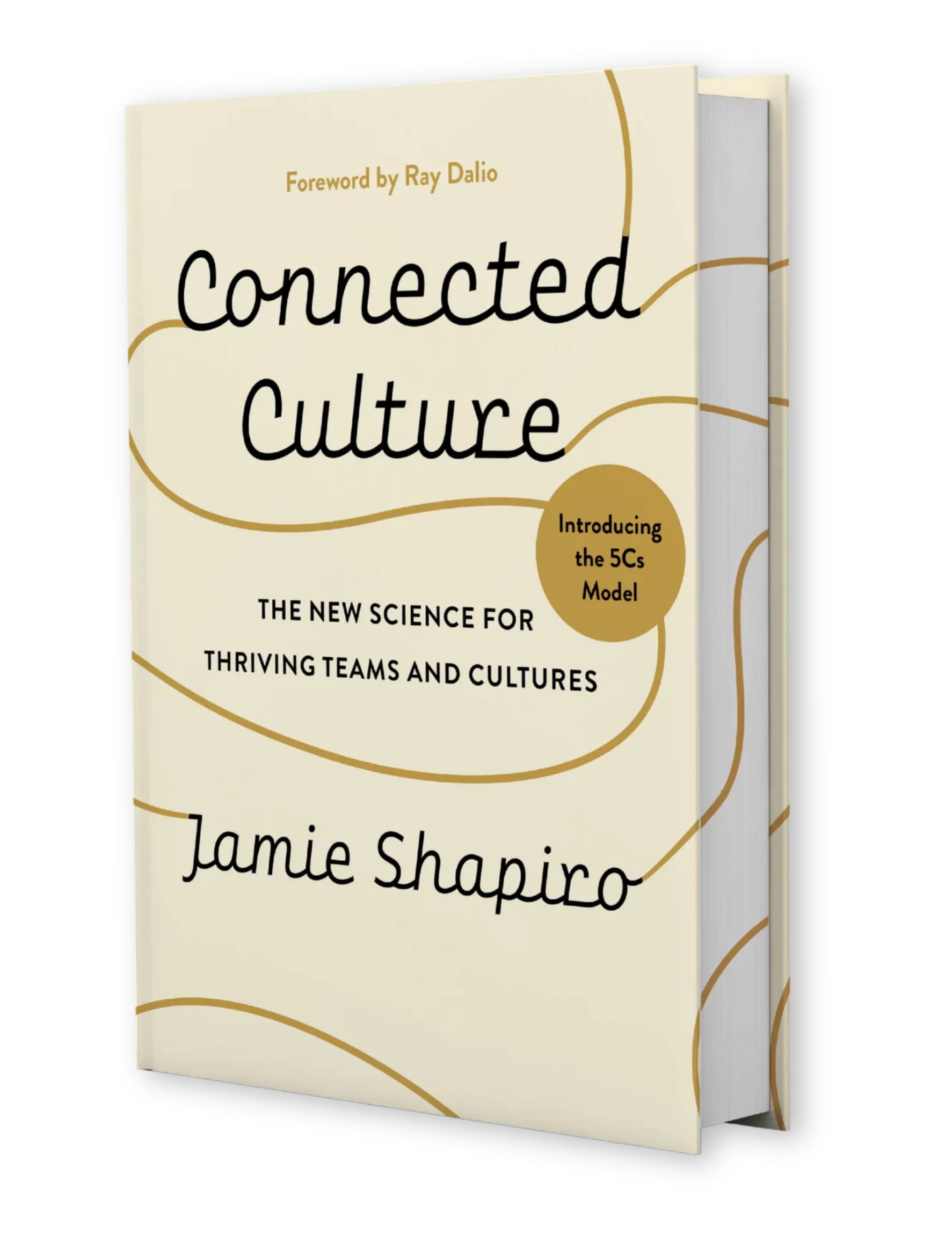
In my book Connected Culture, I place well-being at the very center of the model, as a subfactor of Connection, which our research shows is the single most critical driver of team cohesion and thriving cultures. That placement was intentional. Well-being isn’t a perk. It’s not a yoga class or a fruit bowl in the kitchen. It’s foundational to everything else a team is trying to build.
But here’s what I see over and over again: leaders who genuinely champion culture, who invest in trust, psychological safety, candid communication, yet completely neglect their own energy. They pour into the system and never replenish. And then they wonder why things stall.
You cannot build Connection when you’re depleted. You cannot foster Candid Communication when you’re too exhausted to listen. You cannot create psychological safety when your nervous system is in fight-or-flight mode. Your vitality is the starting condition for your entire culture.
What’s actually draining you
Most leaders assume the problem is volume, too many meetings, too many decisions. And yes, those matter. But in my research on Fortune 1,000 CEOs, I found something more specific. I interviewed twenty of the most pressured leaders in the country about what drains and builds their vitality, which I define as positive aliveness, the inner resource that includes your physical, psychological, emotional energy and spiritual energy. It sits on the opposite end of the spectrum from burnout.
The drains weren’t just about workload. They were about the hidden psychological costs of leadership itself.
Seventy percent of the CEOs I interviewed identified the emotional labor of their role, the requirement to always appear “on,” positive, and composed, regardless of what they actually feel. Nearly half cited the constant need for self-control, suppressing their own reactions in service of the organization. And 85 percent pointed to loss of calendar control, back-to-back meetings, low-value tasks, and reactive firefighting, as a primary energy drain.
In Connected Culture, I write about how the Covara leadership team was caught in exactly this pattern. People were working around the clock, weekends included. One look at their calendars showed back-to-back meetings with no time to think, transition, or even care for basic needs. They had a team culture of firefighting, and zero space for the strategic thinking and reflection that actually moves organizations forward. Well-being was seen as a luxury not afforded to top executives.
That story isn’t unusual. It’s the norm. And it’s quietly undermining culture efforts everywhere.
A Wellness App Won’t Save You
The default response to burnout in most organizations is programmatic: a wellness app, a mental health day, an initiative that lives outside of how work actually operates. In my book, I’m direct about this: workforce well-being driven mostly by corporate wellness programs has had the same focus for far too long, with lower results in recent years. These programs don’t encompass what it truly means to flourish in the workplace.
Making a real improvement requires fully integrating well-being into the business and day-to-day operations as a foundation for leadership, team, and organizational culture. Systemic change needs to happen.
The question most organizations keep asking is “How do we do more with less?” The better question, and one I push every leadership team I work with to sit with, is: How do we design work in a way that sustains performance over time?

What actually builds vitality back
Every CEO I interviewed pointed to specific, daily well-being practices that restored their energy. The top drivers:
Relationships (cited by every single participant): Quality connections with family, with teams, with frontline employees, were the number one source of energy. This aligns with what I share in Connected Culture: the strength of our relationships creates the foundation for team performance and thriving cultures. Gallup’s research confirms it: having a best friend at work is the number one predictor of job satisfaction.
Physical health (85%): Exercise, sleep, nutrition. Leaders know this matters. They just chronically deprioritize it. One CEO told me, “I sleep. It’s probably the one thing I do. I go to bed early and try to always get eight hours.” Simple. Radical.
Accomplishment (65%): Not in a competitive sense, but in the satisfaction of a well-executed plan coming together.
Calendar control (75%): White space. Thinking time. The ability to prepare rather than just react. One CEO captured it perfectly: “The days I have the most vitality are when I have created space throughout the day.”
None of these are revolutionary insights. But they are revolutionary practices, because almost no one actually protects them.
The mirror effect
This is where burnout becomes a culture problem, not just a personal one.
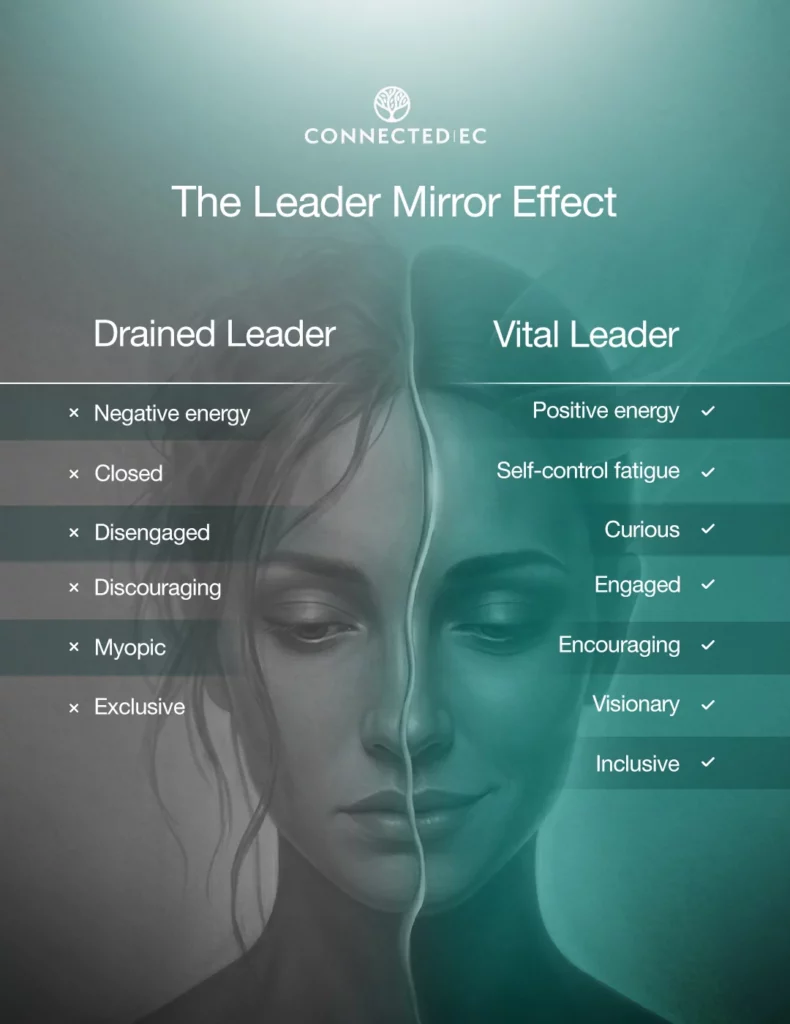
My research identified eight opposing leadership behaviors that shift depending on a leader’s vitality level. When leaders are vital, they transfer positive energy, listen with curiosity, create encouraging and inclusive environments, and think with greater capacity and vision. When drained, the opposite: they transfer negative energy, become closed off, lose patience, and make slower, worse decisions.
In Connected Culture, I talk about how Paul Zak’s neuroscience research found that people at high-trust companies report 74 percent less stress, 106 percent more energy at work, and 50 percent higher productivity. But here’s the thing, trust doesn’t build itself. It requires a leader who shows up present, open, and regulated. A leader running on empty can’t create the conditions for trust, and without trust, nothing else you’re trying to build holds together. Not communication, not clarity, not collaboration. It all starts here.
Your team doesn’t just hear your words. They sync to your state. When you walk into a room drained and distracted, that becomes the standard, whether you intended it or not.
Your one move this week
Before your first meeting tomorrow, take two minutes. Not to check email. Not to review the agenda. Just to reset.
Notice your energy level, honestly. Then ask yourself: Am I about to transfer vitality or depletion into this room?
If the answer is depletion, change one thing. Push a meeting. Take a walk. Step outside. You’re not being weak. You’re protecting the most important leadership resource you have.
In Connected Culture, I share a simple practice we implemented at Covara: starting every meeting with a real check-in. Not an icebreaker. A genuine question: How is your energy: green, yellow, or red? It takes sixty seconds. It changes the entire tone. And it signals something powerful: your well-being matters here.
Try it tomorrow. Start with yourself first.

Your vitality isn’t separate from your leadership. It is your leadership. And it’s the starting condition for every culture you’re trying to build.
— Jamie