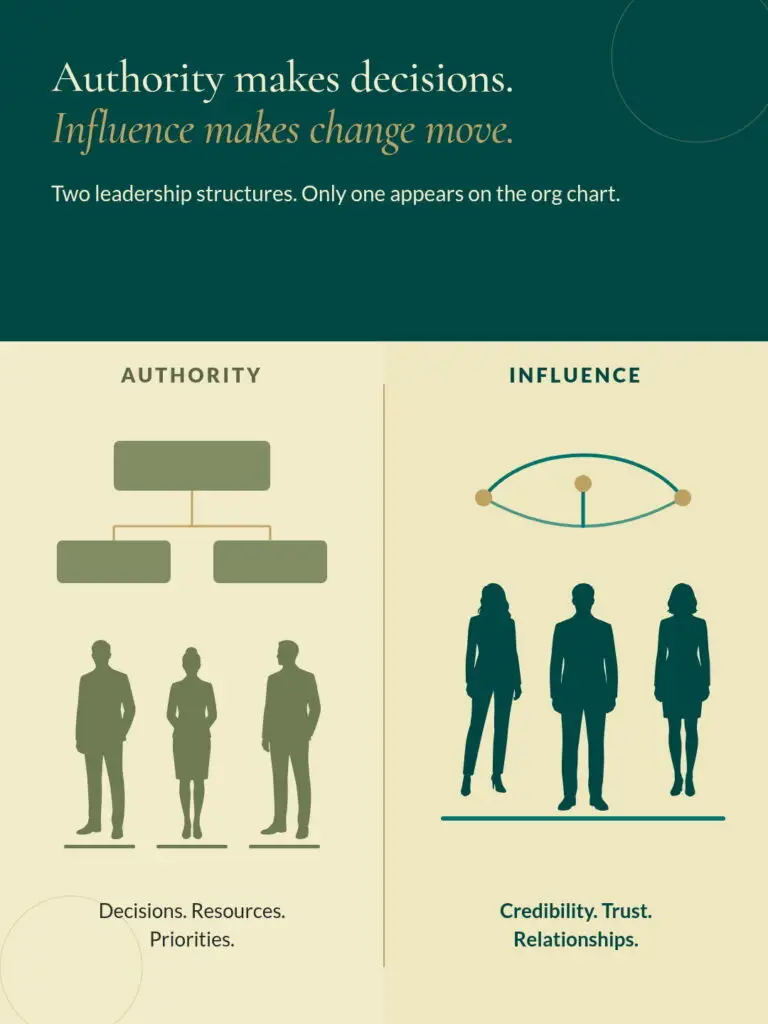
Every organization has two leadership structures. One appears on the organizational chart. The other lives in the relationships between people.
The first tells us who has authority. The second reveals who has influence.
And when organizations are trying to create meaningful change, they may be paying far too much attention to the first and not nearly enough to the second.
Think about how most organizations approach transformation. They assemble executive steering committees, identify senior sponsors, develop communication strategies, and equip managers to cascade messages.
All of these efforts have value. But they often overlook a fundamental question: Who do people actually listen to?
Through my work with executive teams and organizational network analysis, I’ve seen how some of the most influential people in an organization have little formal authority.
They’re the colleagues others seek out for advice. The trusted voices who help people make sense of uncertainty. The individuals who connect people across organizational boundaries.
And sometimes, they’re the people who leave everyone around them feeling more energized, capable, and hopeful.
What if these individuals are among our most valuable, and most overlooked, catalysts for change?
The Difference Between Authority and Influence
Positional authority gives leaders the ability to make decisions, allocate resources, and establish priorities.
Influence is different. It develops through relationships, credibility, trust, and repeated interactions.
Research by Cross, Borgatti, and Parker (2002) demonstrated how organizational network analysis can reveal informal relationships that traditional organizational charts fail to capture.
And research by Battilana and Casciaro (2012), examining 68 organizational change initiatives, found that the structure of change agents’ informal networks influenced their ability to drive change.
The implication? Effective change leadership isn’t simply about having authority. It’s about understanding the relationships through which people make sense of change and decide whether to move forward.
But I think there’s another dimension we’re overlooking.
Not All Influence Creates Positive Momentum
Some people are influential because of their expertise. Others connect colleagues across teams or help people navigate ambiguity.
And some are influential because of the energy they create in their relationships.
This last group particularly fascinates me.
Research by Owens and colleagues (2016) found that positive relational energy experienced through interactions with leaders predicted subsequent work engagement and was positively associated with later performance through engagement.
We all know people who leave us feeling more capable, optimistic, and motivated after a conversation. They don’t necessarily solve our problems. Something about the interaction helps us find the capacity to move forward.
And we know people who have the opposite effect.
Both may be influential. But their impact on others is profoundly different.
This raises a question I’ve been thinking about: What happens when the people others trust are also the people who help them find the energy to move forward?
The Influence–Energy Matrix
I believe we need to consider two dimensions together: how broadly someone influences others within an organization and the extent to which their interactions generate positive relational energy.
These dimensions create four possibilities.
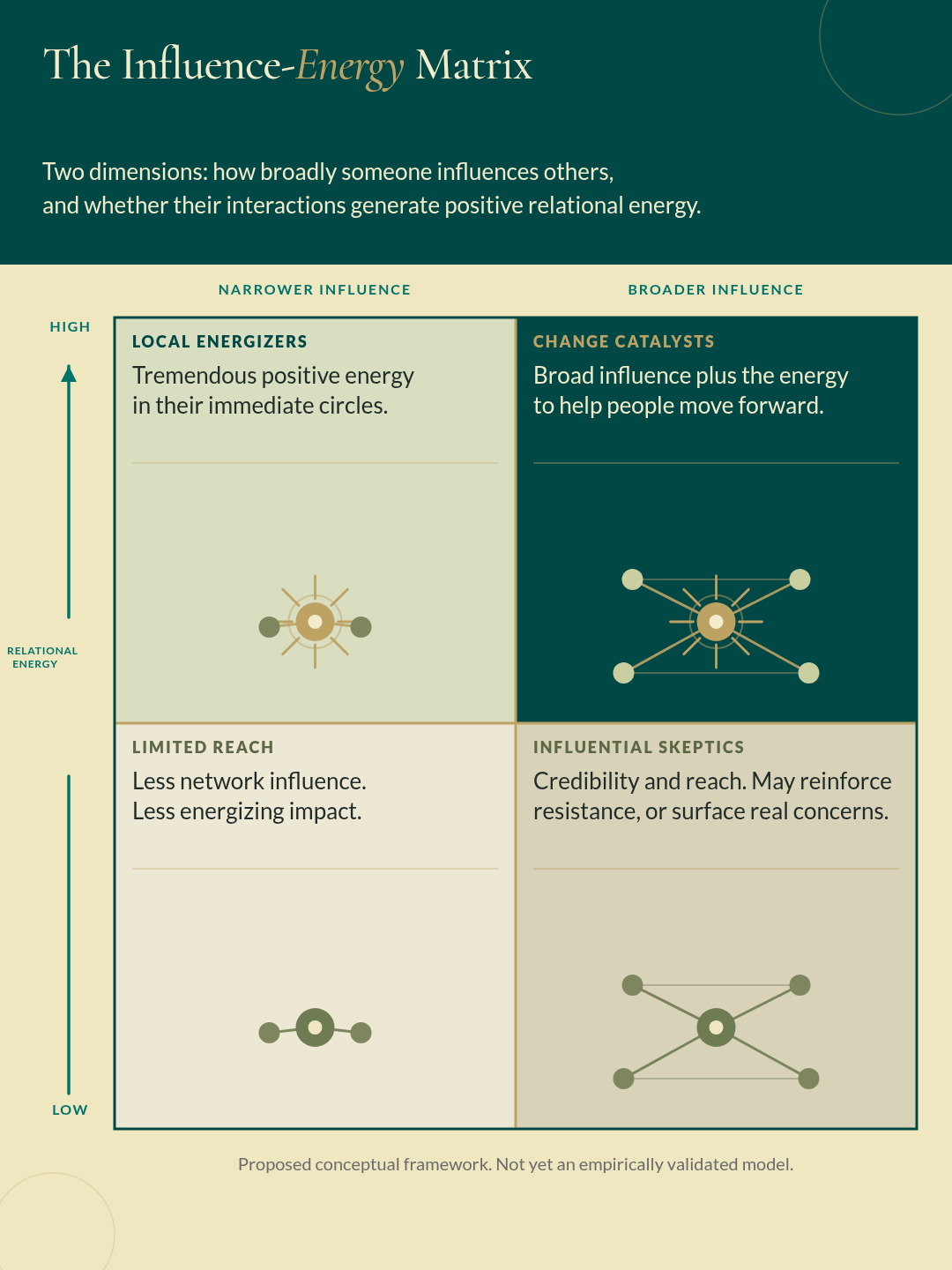
Local Energizers: Individuals who create tremendous positive energy within their immediate circles, even if their broader organizational reach is limited.
Influential Skeptics: People with significant credibility and reach whose interactions may reinforce resistance or uncertainty. Importantly, their skepticism may also surface legitimate concerns leadership needs to hear.
Limited Reach: Individuals with less network influence and less positive energizing impact, but potentially valuable perspectives and untapped capabilities.
Change Catalysts: Individuals who combine broad network influence with the ability to generate positive relational energy.
It’s this final group that I find especially compelling.
They have the relationships to reach others and the relational capacity to help people feel more capable of moving forward.
To be clear, this matrix is a proposed conceptual framework, not yet an empirically validated model. We have evidence connecting informal networks to organizational change and relational energy to engagement and performance. What we haven’t established is whether the intersection of these two dimensions creates a distinctive advantage during transformation.
But I believe it’s a question worth investigating.
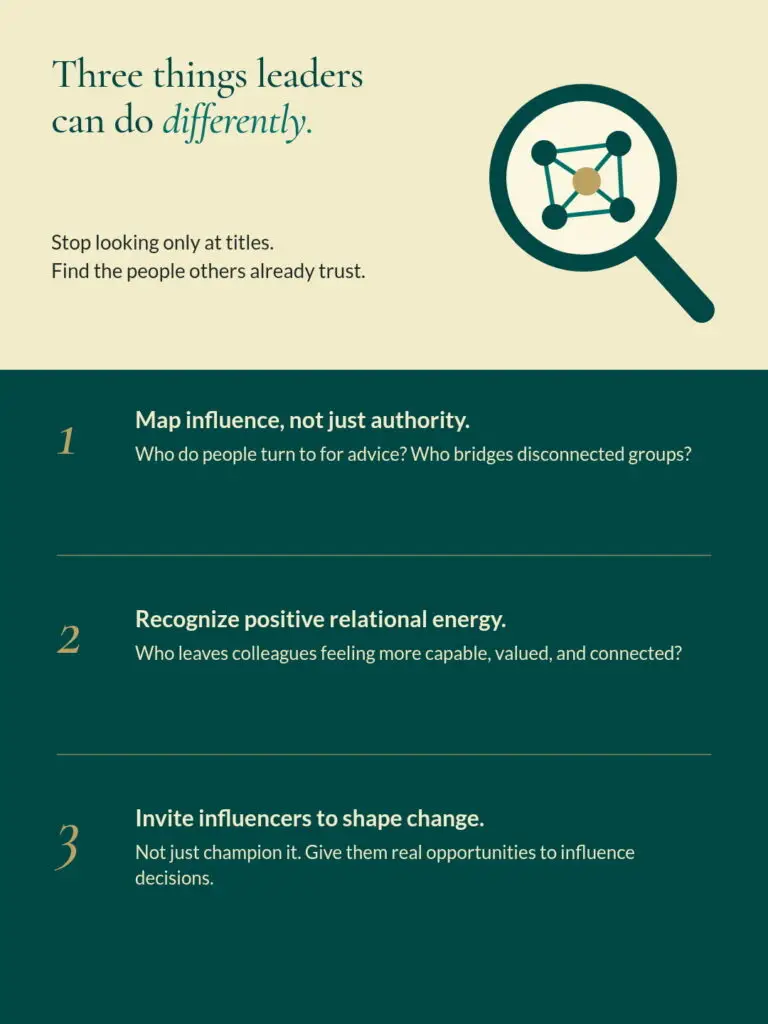
Three Things Leaders Can Do Differently
1. Map influence, not just authority.
Look beyond your organizational chart. Who do people turn to for advice? Who connects different teams? Whose perspectives carry credibility?
Organizational network analysis can help reveal these relationships. And remember, the most connected people aren’t necessarily the most important. Those who bridge disconnected groups may be just as valuable.
2. Recognize the people who generate positive relational energy.
Pay attention to what happens after people interact.
Who helps others see possibilities? Who builds confidence without dismissing legitimate concerns? Who leaves colleagues feeling valued, capable, and connected?
Positive energizing isn’t the same as constant optimism. People can challenge assumptions, raise difficult issues, and still leave others feeling more constructive and capable.
3. Invite informal influencers to shape change, not just champion it.
This may be the most important shift.
Too often, organizations identify influential employees, give them a change champion title, and ask them to convince everyone else to get on board.
Instead, invite them into the process early. Ask what they’re hearing, what leadership might be missing, and what would make the change more meaningful and workable.
Give them genuine opportunities to influence decisions.
And don’t forget to protect their vitality. We cannot continually ask positive energizers to sustain everyone else’s energy without considering what sustains theirs.
Leadership Is Bigger Than a Title
This is one of the reasons I developed the 5Cs Model of team and organizational effectiveness: Connection, Candid Communication, Clarity, Collaboration, and Contribution.
These five dimensions remind us that performance isn’t simply the sum of individual capabilities. It emerges from the relationships and conditions that enable people to thrive together.
Informal influencers can help strengthen those conditions, but formal leaders remain responsible for creating the environment in which they flourish.
The next time you’re preparing for a major transformation, don’t just ask who should be on the executive steering committee.
Ask who people trust. Who they turn to. Who connects them. And who helps them believe they can move forward together.
Because some of the most important leaders in your organization may be people you’ve never thought to call leaders.
Want to learn more about building the relationships, energy, and conditions that help organizations thrive? Explore our work at https://www.connectedec.com.