Leaders consistently underestimate the power of positive reinforcement. Most employees can remember the last piece of criticism they received in vivid detail. Many struggle to remember the last time a leader genuinely recognized something they did well.
The issue is that meaningful recognition and appreciation are far too rare, and many leaders don’t understand the important difference between the two. We confuse two different things and only rarely do one of them. In fact, 59% of people say they have never had a boss who truly appreciated them.

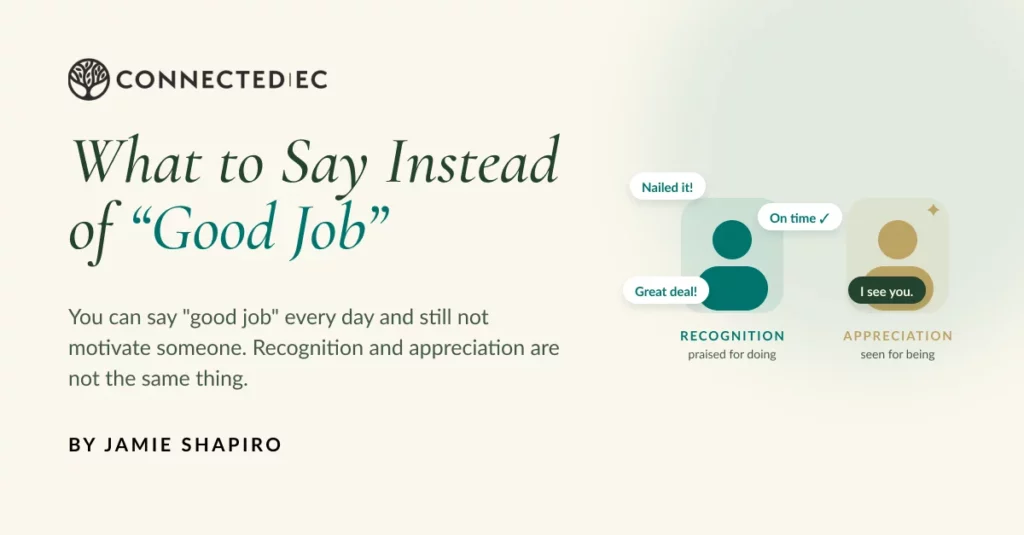
Recognition is for doing. Appreciation is for being
Recognition is tied to results. It rewards what someone accomplished: the deal closed, the deadline hit, the project shipped. Appreciation is about the person, who they are and how they show up, regardless of the outcome.
Both matter. Most teams pour everything into the first and almost nothing into the second. When the only time people feel seen is when they produce, they learn that their worth is their output. The psychologist Isaac Prilleltensky describes mattering as two things at once: feeling valued, and being able to add value. Zach Mercurio, who studies mattering at work, turns that into something a leader can actually do: notice people, affirm the specific difference they make, and show them they’re needed. “Good job” does none of those.
Your strongest people are often the least appreciated
We assume high performers don’t need it. Their results speak for themselves, so we skip the part where we tell them they matter beyond the work.
So the people carrying the most weight get a steady stream of recognition and almost no appreciation. They are praised constantly and seen rarely. Over time, that gap is what makes them restless, even when nothing is obviously wrong.

What actually moves people
That sense of mattering is now something the U.S. Surgeon General treats as a core part of workplace mental health. And it holds people in place: 53% say they would stay longer somewhere they felt more appreciated.

Why more recognition won’t fix it
When a leader senses something is off, the instinct is to add more recognition. More shout-outs, more awards, more bonuses.
But recognition is conditional by design. It arrives only when you deliver, which raises the price of being seen. People start chasing the next win to feel valued instead of feeling secure enough to do their best work. You can recognize someone every week and still leave them wondering whether you’d notice them at all if they stopped performing.
There’s a physical version of this, too. When researchers scanned people’s brains, sincere praise activated the reward system more than flattery did. We can feel the difference between feedback that actually sees us and feedback that is just noise, even when the words are the same.
Appreciation can’t be a program
The fix is not another awards program. The moment appreciation becomes a system, it becomes conditional again.
It is smaller and more personal than that. It means naming what you value about how someone shows up, not only what they delivered: the patience they bring to a hard conversation, the way they steady the room when things get tense. These take ten seconds, and most leaders don’t say them out loud.
One thing to try this week
Close one meeting by appreciating the being of one person. Name a quality or the way they show up, not a result they produced. If you want to do it at the team level, try the Prism of Praise: give everyone a sheet and a few minutes to write one real strength they see in each person. If it’s just you and one report, a single specific sentence does the same work. Keep it on who they are, not what they did.
Recognition tells people their work matters. Appreciation tells them they matter. Your best people already know their output is good. What they’re unsure of is whether you see anything more than that.
— Jamie