A few years ago I worked with a company that would not let me use the word failure. Not in a workshop, not on a single slide of the company’s materials. They weren’t careless about it. They believed that keeping the language positive would keep the team positive.
The trouble was that the company was struggling, and all of the status reports looked great.
That is the cost of treating failure as a dirty word. When a team can’t name what’s breaking, they can’t fix it. The problems that could have been caught early surface late instead, and by then they cost far more.
We punish almost everything as if it were carelessness
Most of us hear failure and picture one ugly thing: someone who dropped the ball. Amy Edmondson’s research shows how distorted that is. When she asks executives how many of the failures in their organizations are truly blameworthy, the answer is usually 2 to 5 percent. When she asks how many are treated as blameworthy, it jumps to 70 to 90 percent.
So most of what gets punished as a careless mistake was nothing of the kind. People notice that, and they adjust. They stop raising their hand.

Excellence and perfectionism look identical from the outside
Two decades of coaching leaders has taught me that excellence and perfection are opposites underneath.
Excellence holds a high standard and expects people to learn when something goes wrong. Perfectionism holds the same standard but treats mistakes as something to hide. One gives people permission to say a project is off track. The other teaches them to protect themselves and stay quiet.
A perfectionist culture runs on fear, and fear runs on silence. That is why this is a performance problem, not a morale one. Teams that learn from their failures and celebrate progress are up to 25 times more likely to succeed over the long term.

Not every failure deserves the same label
Edmondson describes failure as a spectrum. At one end are the smart ones: the experiments and calculated bets where being wrong is how you learn. In the middle are failures that come from complexity and uncertainty, where the useful question is what broke down, not who. At the other end are failures of carelessness or neglect, which call for a direct, private conversation.
Most organizations treat all three the same. When people know a thoughtful risk will be judged like a careless mistake, they stop taking risks. You get a team that plays it safe and waits to be told what to do, which feels like safety and slowly stops the company from learning.
The teams that admit more mistakes perform better
Edmondson saw this while studying hospital teams. The highest-performing teams were recording more errors than the weaker ones. Her first assumption was that they were making more mistakes. They weren’t. They simply felt safe enough to surface them, which meant problems got fixed before they grew. The number that looked worse on paper was the sign of a healthier culture underneath.
What actually changed at my client’s company
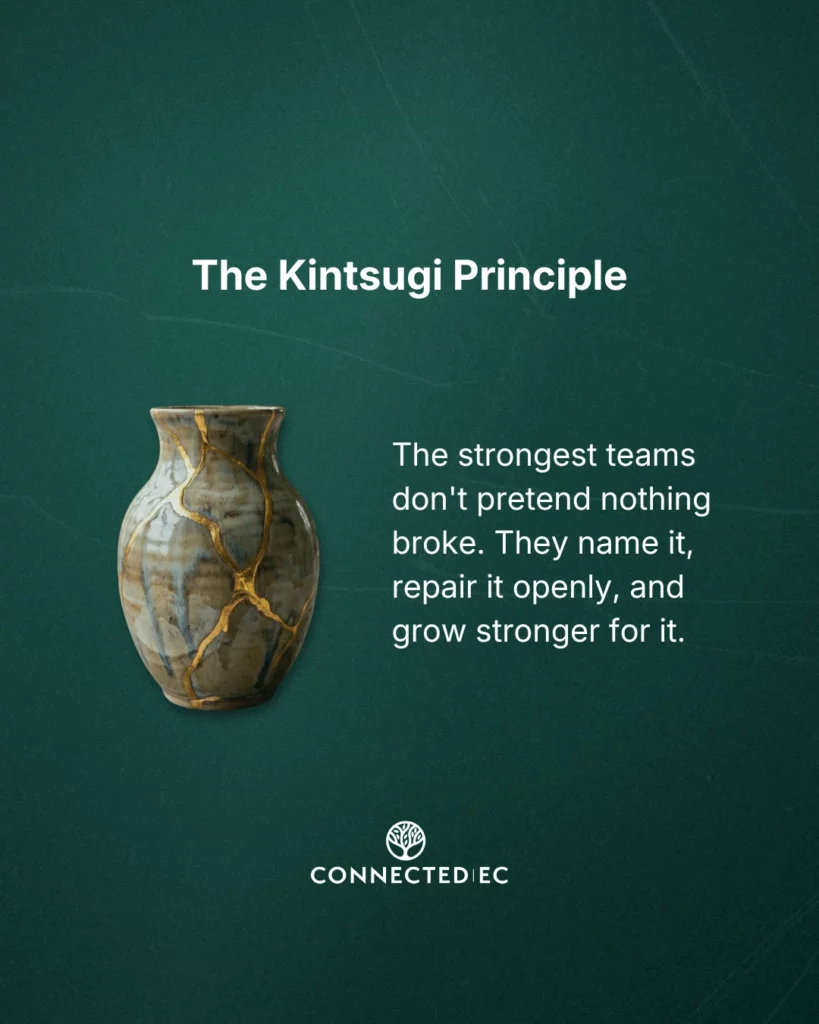
We stopped avoiding the word failure and built a small practice around it, borrowed from kintsugi, the Japanese art of repairing broken pottery with gold so the cracks show instead of disappear. The repaired piece is considered stronger for having been broken.